
Car storage during deployment comes down to three questions: who will drive the car, what coverage you can safely pause, and what your state DMV requires before you drop insurance. This guide walks through each one in plain steps, with the federal Servicemembers Civil Relief Act (SCRA) protections that apply to car loans, leases and storage liens.
General information, not legal or insurance advice. Rules vary by state and by policy. Checked October 2026.
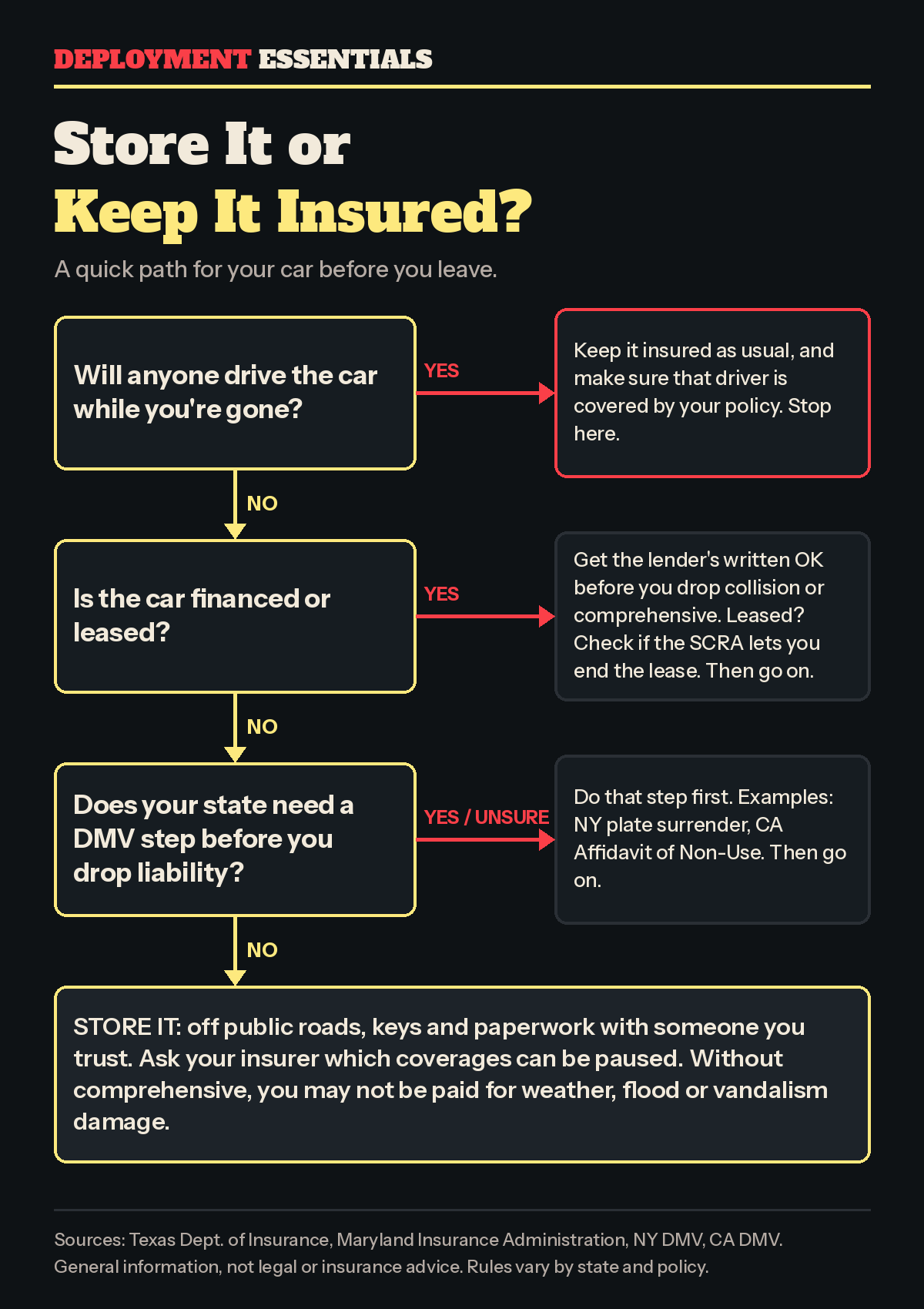
If you only need the short version, start with the decision chart below. Then read the section for your state and your loan or lease before you call your insurer.
Step 1: Decide if anyone will drive it
Everything else depends on this answer. If a spouse, relative or friend will drive the car while you are away, the car is not really in storage. Keep it insured as usual and confirm with your insurer that the driver is covered.
If no one will drive it, you have more choices. The Texas Department of Insurance says that if you will not be driving your car for a long time, “you might be able to suspend your coverage to save money.” It adds a condition: to suspend liability coverage, you have to store the car so no one else can drive it.
Step 2: Know what each coverage does in storage
Insurers use different names for a stored-car setup, so ask about each coverage by name. The table below follows how the Texas Department of Insurance and the Maryland Insurance Administration describe each one. Your policy and your state’s rules control what you can actually change.
| Coverage | What it pays for | If you pause it while the car is stored |
|---|---|---|
| Liability | Other people’s costs if you or someone driving your car causes a wreck | Texas regulators say the car must be stored so no one else can drive it. Many states require liability while the car is registered, so check your DMV first. |
| Comprehensive (“other than collision”) | Damage not caused by a wreck, such as weather, flood, vandalism or hit-and-run | Maryland regulators warn you may not be paid for that damage. Texas regulators say collision and comprehensive might pay if the car is damaged in storage. |
| Collision | Damage to your car from a wreck | Maryland regulators say to ask whether it can be suspended. If you have a loan, the lender usually requires it. |
| Uninsured/underinsured motorist, medical payments, personal injury protection, rental reimbursement, towing and labor | Additional protection if you or someone driving your car has a wreck | Texas calls these optional and says you might be able to suspend them. Rules differ by state. |
Two cautions come straight from the regulators. First, if you financed the car, the Maryland Insurance Administration says your lender may require collision and comprehensive as a condition of the loan, and you should not suspend them “without your lender’s prior written agreement.” Second, the Texas Department of Insurance notes that suspending coverage is not the same as letting it lapse, and that “companies may also charge higher rates if you’ve had coverage lapses longer than 30 days.” Suspending coverage also means you cannot file claims for that coverage while it is paused.
Some states add protection on the back end. In Maryland, the Insurance Administration says auto insurers may not nonrenew, cancel or raise premiums for military personnel returning from active duty overseas solely because they did not meet the insurer’s continuous coverage requirement, unless the gap existed before the assignment.
Step 3: Check your state’s registration and insurance rules
Registration, plates and insurance are tied together by state law, and the rules are not the same everywhere. Here are three examples from official state pages. If your car is registered somewhere else, find your state’s motor vehicle office through USA.gov’s state motor vehicle services list and ask the same questions.
New York: keep coverage or surrender plates
The New York DMV is direct about it:
“You are required to maintain continuous coverage while deployed, or to surrender your plates before being deployed.”
New York State DMV, Information for Military and Veterans
New York’s plate page says to surrender plates before you cancel liability insurance. The NY DMV military page also extends registrations for up to 60 days after you return to New York from active duty, and you still have to keep liability insurance during that extension. It lists forms a second party can use for you.
California: notify the DMV before you cancel
The California DMV says you must notify it before you cancel insurance. If the car is not being driven and is not parked on a California roadway, you can file an Affidavit of Non-Use (REG 5090), and after that the insurance may be cancelled. When renewal comes due and the car is still not in use, you either pay the fees or file for Planned Nonoperation (PNO).
PNO means the car will not be driven, towed, stored or parked on public roads or highways for the entire registration year, so a car stored on the street does not qualify. The DMV accepts PNO filings up to 60 days before and up to 90 days after the registration expires, but it warns that California has no grace period and late filings carry penalties. One more California detail matters here: the DMV says comprehensive or collision coverage alone does not meet the state’s financial responsibility requirement.
Texas: renew from out of state, inspect when you return
The Texas DMV lets a Texas resident serving out of state self-certify that the vehicle is out of state and renew the registration without a Texas inspection, online, by mail or in person. The state’s part of the inspection fee is still charged, and active duty members may be able to get it refunded with a form from a TxDMV Regional Service Center. After you return, the car must be inspected within 3 days, according to both TxDMV and the Texas Department of Public Safety.
Step 4: Use your SCRA protections
The SCRA does not pause your insurance, and it does not cancel what you owe. It does add specific protections for car loans, leases and storage. The Justice Department’s SCRA guide and the Consumer Financial Protection Bureau explain the details.
- Storage liens. The Justice Department says a towing or storage company cannot enforce a lien on a servicemember’s property during military service or within 90 days after it unless there is a valid court order. The law, 50 U.S.C. 3958, covers liens for storage, repair or cleaning, and a knowing violation is a misdemeanor. You still owe the storage bill.
- Repossession. If you bought or leased the car before entering service and paid a deposit or at least one installment before service, the creditor cannot repossess it during service without a court order, according to the Justice Department and the CFPB. The CFPB adds that you can still be charged late fees, reported to credit bureaus and sued for the debt, so keep paying.
- Ending a car lease. The CFPB says you may be able to end an auto lease without penalty if you signed it before being called to active duty for 180 days or longer, or signed it while on active duty before getting qualifying orders, such as a PCS from the continental U.S. to overseas or a deployment of 180 days or longer. Under 50 U.S.C. 3955, you give written notice with a copy of your orders and return the vehicle within 15 days of the notice. The leasing company can’t charge an early termination fee, but you still owe unpaid lease amounts up to the termination date, plus taxes, fees and reasonable charges for excess wear, use or mileage. The Justice Department says lease amounts you paid in advance for the period after the lease ends, including a capitalized cost reduction, must be refunded.
If a lease or loan question is close, take your orders and paperwork to your installation’s legal assistance office before you act.
Step 5: Set up car storage during deployment
Once the insurance and DMV pieces are settled, set up the storage itself. Items 4 and 5 come from Military OneSource. The rest is general advice.
- Pick an off-road spot. A garage, a family member’s driveway or a storage facility. In states like California, being off public roads is part of the rule, not just good practice.
- Get storage terms in writing. If you use a facility, know the monthly cost, who can access the car and how billing works while you are away. Set up automatic payment so a missed bill does not turn into a lien fight.
- Follow your owner’s manual. As general advice, check the manual’s long-term storage section for the battery, tires and fuel before you park it.
- Fill out a vehicle log. Military OneSource’s Predeployment Vehicle Maintenance Guide has you record where the spare key is, your insurance contact and a trusted person who will help with the car. It says to keep one copy in the car and one at home.
- Give a trusted person authority. Military OneSource notes a limited power of attorney can let someone you trust handle vehicle transactions for you. Our pre-deployment paperwork checklist covers how to set that up.
- Keep it quiet. Don’t post that the car will sit unused or that you are leaving. Tell only the people who need to know.
Before you leave: a quick checklist
- Decided whether anyone will drive the car
- Asked your insurer, by name, about liability, collision, comprehensive and optional coverages
- Got your lender’s written OK before changing collision or comprehensive
- Completed your state’s DMV step, such as plate surrender, a non-use filing or out-of-state renewal
- Reviewed your SCRA options for the loan or lease
- Stored the car off public roads, with keys, copies and authority left with someone you trust
Checked October 2026 against the Justice Department, the Consumer Financial Protection Bureau, the New York, California and Texas motor vehicle agencies, the Texas Department of Insurance and the Maryland Insurance Administration. This is general information, not legal or insurance advice.