
Gear gets all the attention before a deployment, but the paperwork is what protects the people you leave at home. This pre deployment checklist covers the admin half of getting ready: the forms, legal documents, bills and accounts that should be finished before you go, so nobody has to sort them out while you are unreachable.
If you are still working on the physical side, start with our hot, dry climate packing list. Then come back here and work through the nine items below. Nearly everything here comes from official sources, and you can read each page yourself. Where a tip is general advice instead, we say so.
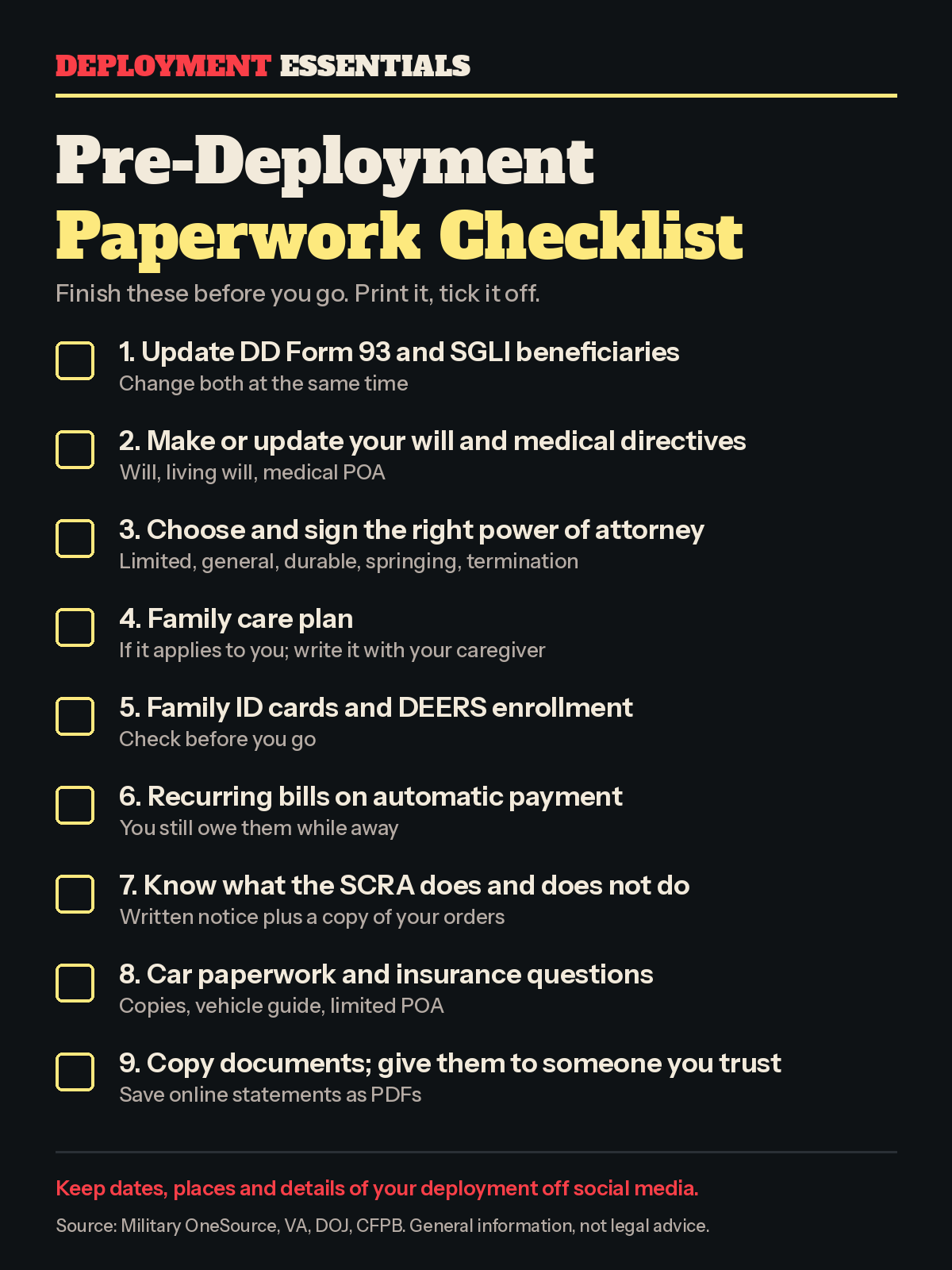
The pre-deployment checklist at a glance
- Update your Record of Emergency Data (DD Form 93) and SGLI beneficiaries
- Make or update your will and medical directives
- Choose and sign the right power of attorney
- Put a family care plan in place (if it applies to you)
- Check family ID cards and DEERS enrollment
- Get recurring bills on automatic payment
- Know what the Servicemembers Civil Relief Act does, and does not, do
- Sort out your car paperwork and insurance questions
- Copy the documents and hand them to someone you trust
1. Update your DD Form 93 and SGLI beneficiaries
The Record of Emergency Data, or DD Form 93, tells the military who to notify if you are seriously ill, injured, missing or die, and it names your beneficiaries for certain benefits. According to Military OneSource, if you do not name a beneficiary, one will be designated for you according to law. It also lets you name the person who directs the disposition of your remains.
Servicemembers’ Group Life Insurance (SGLI) works the same way: it pays the people you picked. The VA says you can review coverage and change beneficiaries online through the SGLI Online Enrollment System (SOES) after signing in through milConnect. Military OneSource adds a rule to remember: when you change your life insurance, you must also update your DD Form 93. Do both in the same sitting.
Military OneSource also lists other places to check beneficiaries while you are at it: bank accounts (ask about “transfer on death”), retirement accounts such as your 401(k), Thrift Savings Plan and IRAs, and stocks, bonds and mutual funds.
2. Make or update your will and medical directives
A will lets you decide what happens to your property and, if you have children, who becomes their guardian, instead of leaving it to a court. If you already have one, Military OneSource says to consider updating it for your current situation.
Three terms get mixed up, so here is how Military OneSource separates them:
- Last will and testament: who gets your property and who raises your children. You also name an executor to carry it out.
- Living will (advance directive): which medical treatments you do or do not want if you cannot decide for yourself.
- Durable medical power of attorney: the person who makes medical decisions for you if you are incapacitated.
Military OneSource offers an Estate Planning Workbook for organizing contacts, documents, accounts and final wishes in one place.
3. Choose and sign the right power of attorney
A power of attorney (POA) lets someone you trust act for you while you are away. The type matters. Military OneSource describes these:
- General POA: broad authority. Some institutions may not accept a general POA for certain transactions.
- Special or limited POA: covers a specific task, such as a bank account, a vehicle or the sale of property. You need a separate one for each purpose.
- Durable POA: keeps working even if you become incapacitated.
- Springing POA: only becomes valid when a certain event happens.
- Termination POA: expires automatically after a set time or event, such as the length of a deployment.
Many families start with a limited POA for specific jobs, such as loan payments or vehicle paperwork. That is general advice, so ask your legal assistance office which type fits your situation. Military OneSource also says to talk with the person first, and make sure a family member can get to your legal documents.
“Discuss your wishes with potential guardians and powers of attorney beforehand, and make sure a family member, whether spouse, partner or parent, can access your legal documents.”
Military OneSource, “Important Deployment-Related Legal Paperwork”
Free help: active-duty and retired service members can get free legal assistance from installation legal services (JAG) offices for wills, powers of attorney, family care plans and more. Military OneSource says you can also use a civilian attorney.
4. Put a family care plan in place
A family care plan is the blueprint for how your family is looked after while you are gone. It usually covers child care, school, medical care, family activities and every contact the caregiver might need. Military OneSource says it is best if you and your caregiver write it together.
It is required for service members who are single parents or part of a dual-member couple with dependents, and for others who are primarily responsible for dependent family members. If that is you, ask your legal assistance office or command what your service requires. If it is not you, a one-page version is still worth writing for whoever helps at home.
5. Check family ID cards and DEERS enrollment
Military OneSource says children should have up-to-date military ID cards before you deploy, because those cards verify their status and let guardians shop on their behalf at the commissary. Everyone in the family also has to be enrolled in DEERS to get many benefits, including TRICARE. Only the service member can add or remove family members, so double-check the enrollment before you go.
6. Get recurring bills on automatic payment
Military OneSource is blunt about one thing: you are still responsible for your bills while deployed. Its suggestions:
- Use automatic payments for recurring bills, either on a credit card that will not expire during the deployment or by direct withdrawal from a bank account that stays active.
- Ask companies whether they will suspend or reduce charges while you are away, even where the law does not require it.
- Consider freezing your credit while you are away to prevent identity theft.
- Talk to your installation’s personal financial management office, or call Military OneSource for free financial counseling.
7. Know what the SCRA does (and does not) do
The Servicemembers Civil Relief Act (SCRA) is real protection, but it is narrower than people think. Here is what the official sources say.
The 6% interest cap applies to debts you took on before military service. The Department of Justice says you can get a 6% cap on most loans you took out, including joint loans with a spouse, before you entered military service. You have to ask: send each lender written notice (an email or portal message counts) with a copy of your orders. The Consumer Financial Protection Bureau (CFPB) says to make the request while serving or within 180 days after release from active duty. Lenders must forgive the extra interest, not just defer it. Because the cap is tied to debts taken on before you entered military service, a loan you signed while already on active duty generally is not covered.
Leases. The CFPB says you can end a home lease without penalty if you signed it before you entered active-duty service, or before you received orders to deploy for 90 days or more (or a permanent change of station). You may also be able to end an auto lease without penalty, but the tests are different: a call to active duty or deployment of 180 days or longer, or a permanent change of station from the continental U.S. to overseas, with the lease signed before you were called up or before you received those orders. For an auto lease, you also have to return the vehicle within 15 days after you give notice. Send your landlord or leasing company written notice and a copy of your orders (or a letter from your commanding officer). For a home lease, the CFPB says the end of the lease takes effect 30 days after the due date of your next payment.
Other protections. Military OneSource also lists a 90-day delay in some civil court matters, protection from eviction for nonpayment without a court order (for rents below a set amount), and no repossession without a court order for pre-service debts.
The SCRA does not erase what you owe. The CFPB notes that lenders can still charge late fees, report missed payments and try to collect. Legal assistance offices can tell you how it applies to your situation.
8. Sort out your car paperwork and insurance questions
You do not need a long list here. You need the right papers in the right hands:
- A copy of your registration and title, your vehicle insurance policy, and your service and maintenance history, kept with a trusted person. Military OneSource suggests keeping copies of vehicle paperwork in the vehicle as well. Military OneSource’s must-have documents checklist includes all three.
- A filled-in vehicle guide for whoever looks after the car: plate and tag expiration, where the registration is kept, the spare key location, and contacts for your shop and insurer. Military OneSource has a free Vehicle Maintenance Guide for this.
- A limited POA if someone needs to handle vehicle transactions for you. Military OneSource names vehicle transactions as a typical use.
- A question for your insurer, your lender or lessor, and your state’s motor vehicle agency before you change coverage on a car that will sit unused: what does each require? Rules vary by state, and a financed or leased car may come with coverage conditions. (This one is general advice, not an official rule.) You can find your state agency through USA.gov’s motor vehicle services page.
If you have not shopped your policy in a while, our guide to auto insurance for military members is a good place to compare.
9. Copy the documents and hand them to someone you trust
Military OneSource’s must-have documents checklist suggests sitting down with a family member or someone you trust and going through the paperwork together. It groups the papers like this:
- Legal: wills (living will and last will), power of attorney paperwork, birth certificates or adoption papers, marriage certificate or divorce papers
- Financial: recent bank, credit card and investment statements, leave and earnings statements, monthly bills, recent tax forms
- Health: your medical history and immunizations, health insurance paperwork, and the same for dependents
- Home: your lease or deed, mortgage paperwork, homeowner’s or renter’s insurance
- Vehicle: registration, title, insurance policy, maintenance history
Save online statements as PDFs so you are not depending on a login. If you picked someone as your power of attorney, include them in the conversation.
Keep the paperwork quiet: OPSEC
Finishing these items is not something to announce. Military OneSource’s security guidance tells service members and families:
- Do not share specific information about a deployment, such as dates, locations, mission details or the other service members involved.
- Do not discuss personal transactions, including a power of attorney.
- Do not advertise that the family is home alone or that a house or car will be empty.
- Avoid signs, stickers or other public displays that show a service member is deployed.
- On social media, do not post dates or locations, and turn off location tagging. Check photo backgrounds for landmarks, last names or units before sharing. As a rule, Military OneSource says it is better not to post anything related to deployment at all.
As general advice, keep scans of these documents out of public posts, shared drives you do not control and large group chats.
After you are home
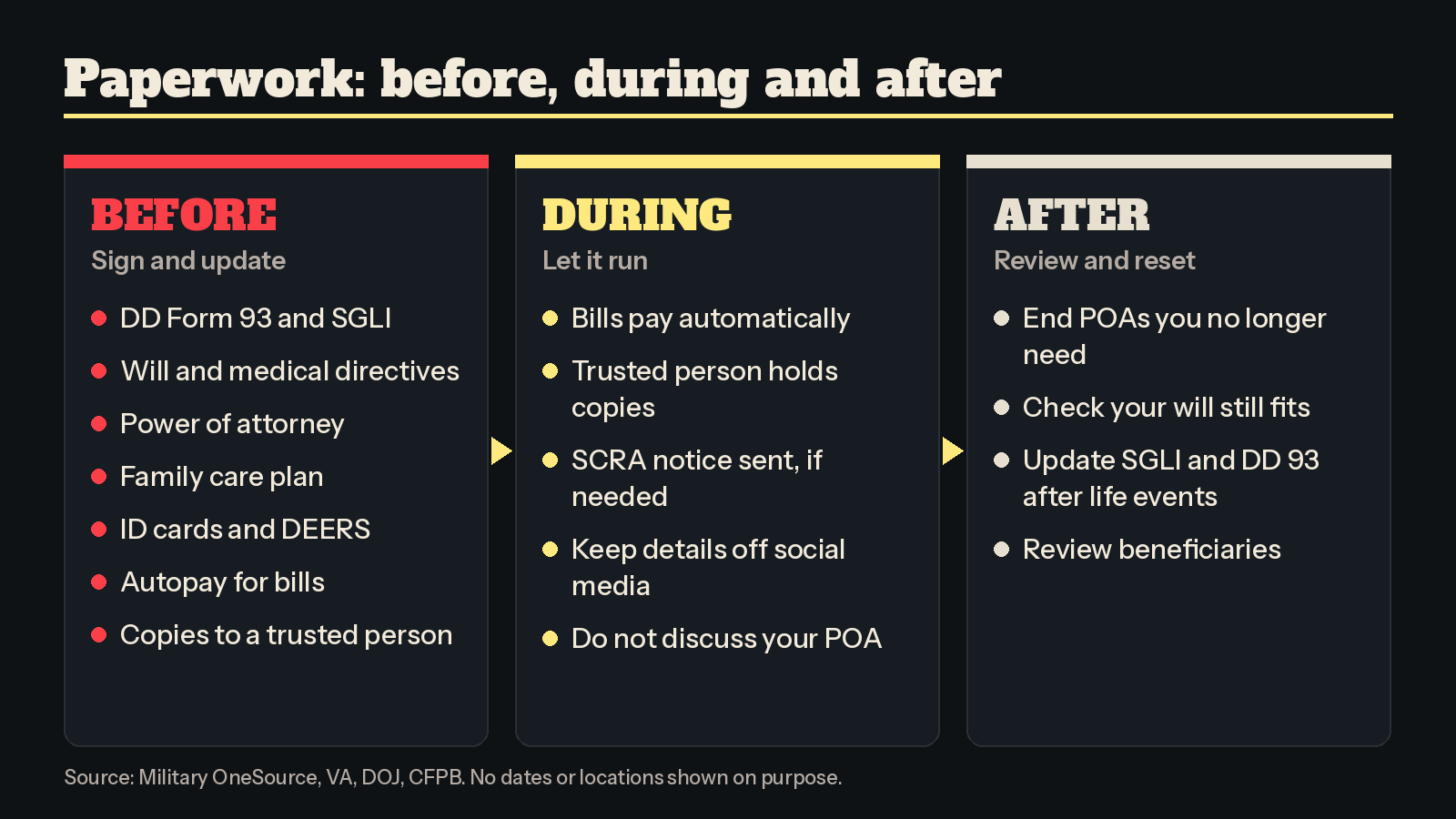
Military OneSource says to revisit your legal arrangements once you return: end any powers of attorney you no longer need, check whether your will still fits, and update anything else that has changed. If a life event happens along the way, such as marriage, divorce, a new child or a beneficiary’s death, update your SGLI and your DD Form 93 then, not later.
Where to get official help
- Military OneSource answers questions and connects you to resources 24/7 at 800-342-9647, with OCONUS calling options and secure chat. It also has Plan My Deployment Checklists for organizing the home front.
- Installation legal assistance (JAG) office: free help drafting your documents.
- Installation personal financial management office: help with bills, entitlements and savings.
- Your installation’s Military and Family Support Center: deployment support programs for your family.
Paperwork done, packing done, and the people at home know where everything is. That is a ready household. Pair this list with your gear list, check each item against the official page, and ask your legal assistance office when something does not fit your situation.
Checked October 2026 against Military OneSource, the VA, the Department of Justice and the Consumer Financial Protection Bureau. This is general information, not legal advice.
Leave a Reply