A military power of attorney is the document that lets a spouse or other trusted person sign and act for a service member who cannot be there in person. Before a deployment, that authority may be needed for a bank account, a vehicle, housing or a household-goods move. This guide explains how a general power differs from a special (also called limited or specific) power, who can get one free at a legal assistance office, what 10 U.S.C. 1044b requires of states, and why a bank or agency may still ask for its own form.
General information, not legal advice. A power of attorney is a legal document, and the details can vary by service and by state. Speak with your installation legal assistance office before you rely on anything here. Checked November 2026.
General vs special military power of attorney
A power of attorney names an agent (sometimes called a grantee) and spells out what that person may do in your name. You are bound by acts the document authorizes, which is why official Navy guidance warns you to choose someone you trust and not grant more power than you need. Military OneSource likewise tells service members to designate someone they trust.
A general power of attorney is broad. The Navy Judge Advocate General’s Corps says a general power gives the agent “the legal authority to do almost anything that you could do,” and that the risk of misuse is high. Its examples include selling a car, borrowing money you would have to repay, renting or buying property in your name, or emptying a bank account. Military OneSource describes the same wide reach (bank accounts, property, insurance and contracts) and adds a practical drawback: some institutions may not accept a general power, or may accept it only for the most basic transactions.
A special (or limited) power of attorney is narrower. The Navy describes it as authority “to perform specific tasks on your behalf, such as registering your car or selling specifically listed property.” Military OneSource puts it the same way: the document is tied to a certain transaction or business relationship, such as a named bank account, a vehicle or the sale of a particular property, and it should include detailed information. The tradeoff, OneSource says, is that you may need a separate special power for each relationship you need to cover.
Navy legal assistance guidance recommends limiting the grant “to only that necessary to accomplish your needs” and, when the job is a specific task such as signing a lease, getting a special power for that task only. Navy offices also require an attorney consultation when a client insists on a general power. That consultation rule is a Navy office practice; other services may handle general powers differently, so ask the office you visit.
| Topic | General power of attorney | Special (limited) power of attorney |
|---|---|---|
| Scope | Almost anything the grantor could do in person, including banking, property, insurance and contracts. | Only the specific tasks or transactions named in the document, such as registering a car or selling listed property. |
| Risk | High potential for misuse, because the agent’s authority is so broad. | Lower, because the agent can do only what the document lists. |
| Acceptance | Some banks and other institutions may refuse a general power, or accept it only for basic transactions. | Often a better fit when a bank or agency wants a document limited to a named account or task. Many still prefer their own form. |
| Typical uses before a deployment | A single document meant to cover many kinds of business. Convenient, but easy to over-grant. | Banking, a vehicle, military housing, household-goods shipment, real estate, mail, insurance or DEERS and TRICARE paperwork, each as needed. |
| How many you may need | Usually one, because the authority is broad. | One for each business relationship or task you need to cover. |
Banking, vehicles, housing and a move
A special power is only as useful as the details it contains. Military OneSource tells a person who will act as agent to have the bank account name and number, vehicle identification numbers, and insurance policy companies and numbers, whether or not those details are written into the document. Navy legal assistance publishes special-power forms for common needs, including basic banking, household-goods shipment, military housing (accepting quarters or signing to terminate them), personal property (including buying, selling or registering a car), real estate, mail, insurance and personnel matters such as DEERS or TRICARE enrollment.
Those uses map to everyday deployment tasks. If a vehicle will be stored, sold or kept on the road by someone else, a limited power that names that vehicle is the usual tool; our guide to insuring a stored vehicle during deployment covers the storage and insurance side. If household goods or on-base housing are part of a move, a special power can let a spouse sign for shipment, accept quarters or end a housing assignment. Our ways to make a military move easier walks through the move itself. Military OneSource also notes that a copy of the power, given to the installation housing office, may allow a family already on a government-housing waiting list to accept those quarters if a home becomes available while the service member is away, and that a general or special power may be needed to enroll a newborn in DEERS so TRICARE coverage can continue after the first 120 days.
Durable vs springing powers
General and special describe what the agent may do. Durable and springing describe when the power starts and whether it survives incapacity. Military OneSource defines the terms this way:
- Regular. Most regular powers take effect when signed and last until they expire, until the grantor revokes them, until the grantor becomes incapacitated, or until either party dies.
- Durable. A durable power usually takes effect when signed and continues until expiration, revocation or death, with special language that keeps the agent’s authority in place if the grantor becomes incapacitated.
- Springing. A springing power does not become valid until a named event occurs. A common use is to have it take effect if the grantor can no longer make decisions. A springing power may or may not have an expiration date.
The Navy’s legal assistance page makes the same core point about durability: unlike a standard power of attorney, “a durable power of attorney remains legally valid if the principal becomes mentally or physically incapacitated.” Navy legal assistance attorneys can prepare and execute those documents so a trusted agent can manage financial, business, real estate and personal affairs during a deployment, a training cycle or a medical emergency. If incapacity is one of the risks you want to plan for, ask the legal assistance office whether a durable (or springing) form fits, rather than assuming a standard special power will keep working in that situation.
Where to get one free, and who is eligible
You do not have to pay a civilian attorney to get a standard power of attorney. Military OneSource says the military maintains legal services offices to prepare powers of attorney for service members, and that those services are free. The official Army benefits page says Soldiers on active duty, and their immediate families and survivors, are eligible for free legal assistance, and it lists drafting powers of attorney and providing notarizations among the services. Navy legal assistance similarly says free legal services are available at a Region Legal Service Office (RLSO), including help preparing common special powers and, when needed, advice before you sign.
The statutory eligibility list is in 10 U.S.C. 1044. Subject to the availability of legal staff, the Secretary concerned may provide legal assistance on personal civil legal affairs to, among others, members of the armed forces on active duty; members and former members entitled to retired or retainer pay; certain Public Health Service and NOAA commissioned officers; reserve members for a period after release from a mobilization of more than 30 days (not less than twice the length of that duty); their dependents; certain surviving dependents; and, in limited cases set by regulation, federal civilian employees serving where non-military legal help is not reasonably available. Offices can still set appointment rules, and the statute itself makes assistance subject to staff resources, so confirm eligibility with the office you plan to visit.
To find that office, use the official Armed Forces Legal Assistance locator at legalassistance.law.af.mil. The locator is built to find active-duty legal offices that offer general legal services in the continental United States. The Army benefits page points to the same locator. The locator page itself also says its office listings are limited to certain locations, so if a search comes up empty, call the legal office on your installation or the next closest one and ask whether it can help. Navy clients who want a common special power can also start with the Navy’s do-it-yourself special power of attorney tool, then sign the document in person before a notary. The Navy page is clear: the power “will not be honored unless it is signed by you, in person, in front of the notary.”
What to bring to legal assistance
Call or check with the office first about appointments, walk-in hours and any worksheet it wants you to complete. The Armed Forces Legal Assistance locator notes that legal worksheets and their ticket numbers may be used at Air Force legal offices; if you filled one out, bring the ticket number. The person granting the power has to appear. Army legal assistance will not work through a friend or relative in the client’s place, and Navy guidance requires an in-person signature before a notary. Ask the office what identification it requires, because that can vary.
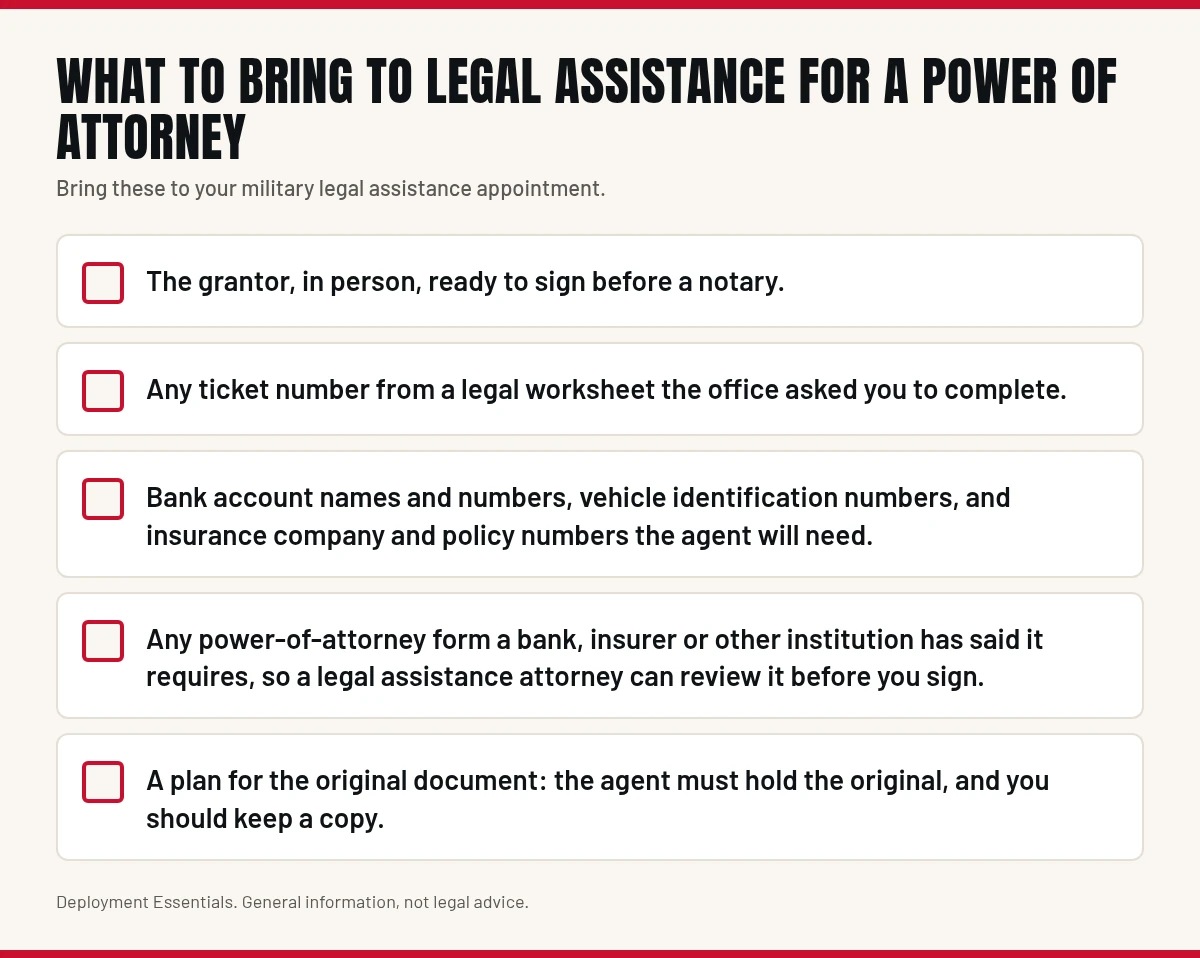
Checklist in text
- The grantor, in person, ready to sign before a notary.
- Any ticket number from a legal worksheet the office asked you to complete.
- Bank account names and numbers, vehicle identification numbers, and insurance company and policy numbers the agent will need.
- Any power-of-attorney form a bank, insurer or other institution has said it requires, so a legal assistance attorney can review it before you sign.
- A plan for the original document: the agent must hold the original, and you should keep a copy.
Military OneSource specifically recommends checking with a bank, insurance company or other institution about its preferred form and filing rules before the legal assistance appointment. The legal assistance attorney can then go over that form with you.
What 10 U.S.C. 1044b requires, and what banks may still ask for
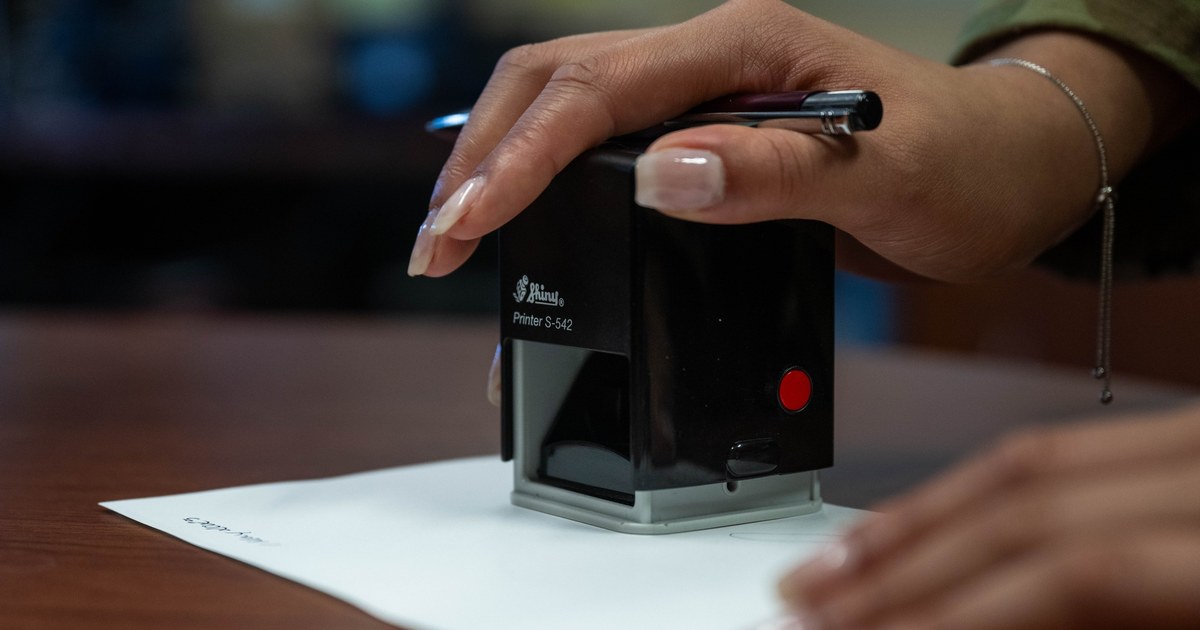
Federal law gives a properly executed military POA special treatment under state law. Under 10 U.S.C. 1044b, “Military powers of attorney: requirement for recognition by States,” a military power of attorney:
“is exempt from any requirement of form, substance, formality, or recording that is provided for powers of attorney under the laws of a State; and”
“shall be given the same legal effect as a power of attorney prepared and executed in accordance with the laws of the State concerned.”
The same section defines a military power of attorney as “any general or special power of attorney that is notarized in accordance with section 1044a of this title or other applicable State or Federal law.” It also says each military power should include a statement of those protections, but that the protections still apply if the statement is missing. “State” here includes the District of Columbia, Puerto Rico and a U.S. possession. The text above is from the official United States Code at uscode.house.gov, current through Public Law 119-142 (November 10, 2026).
That statute is about how states must treat the document. It does not mean every private business has to honor it. Navy legal assistance is direct on this point: “no one is required to accept a power of attorney.” “Many banks, businesses, and organizations have their own specific forms that must be used, and many have chosen not to accept powers of attorney at all.” Its powers-of-attorney page adds: “Most states do not require an individual or business/organization to accept a Power of Attorney (even a military Power of Attorney), regardless of the legality or validity of the Power of Attorney.” The same page says that in some cases, banks and other financial institutions “will only accept a Special Power of Attorney to fulfill specific standards and requirements.” Military OneSource gives the same advice: many financial institutions want customers to use the bank’s own form, so the service member should ask before the legal assistance visit. The Navy’s practical tip is to contact the organization ahead of time and to be as specific as possible about the agent’s authority, which can reduce the risk that the document is rejected.
Expiration dates and how to revoke a power of attorney
Military OneSource says a power of attorney is limited to a set period or to an event, such as the length of a deployment, and that it expires automatically when that period or event ends. The grantor can revoke it at any time while mentally competent. Navy legal assistance adds a service-specific limit: powers drafted by Navy legal assistance offices “are limited in duration to no longer than one year and should only be drafted for the amount of time needed.” That one-year cap is a Navy office rule, not a sentence in 10 U.S.C. 1044b, so do not assume every service uses the same cutoff. Ask the office that prepares your document to print a clear end date, and do not sign a term longer than you actually need.
To end a power early, the Navy says you must sign and notarize a revocation and give a copy to anyone you believe has dealt with, or may deal with, your agent. The Navy also publishes a letter of revocation with its special-power tools. Because it can be hard to reach every third party who might still rely on the old document, Navy guidance calls the difficulty of revocation “one of the inherent dangers in granting a POA.” It also recommends sending the revocation to the agent by a method that produces a delivery receipt, such as certified mail with a return receipt, and, where it fits the situation, recording or publishing notice in the relevant counties. If trust in the agent is gone, go back to legal assistance rather than trying to unwind the document on your own.
This is not legal advice, and it is not a substitute for a conversation with a legal assistance attorney about your own facts. For the other paperwork that usually sits beside a power of attorney, use our pre-deployment checklist rather than repeating those steps here.
Sources: 10 U.S.C. 1044 and 1044b (uscode.house.gov); Armed Forces Legal Assistance locator; Army Legal Assistance Services fact sheet; Navy JAG legal assistance and powers-of-attorney pages; Military OneSource, “Understanding Military Power of Attorney: A Family Primer.” Checked November 2026.