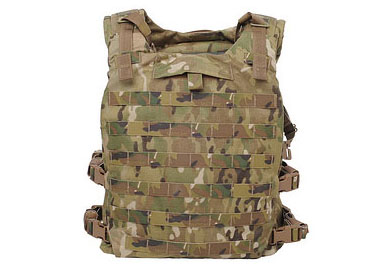
Category: Equipment

  • Liquid Body Armor – a Stronger & Lighter Body Armor Solution

    Liquid Body Armor – a Stronger & Lighter Body Armor Solution

    Engineers at BAE Systems are in the process of developing path-breaking body armor. The new armor is called “Liquid Armor” or “Liquid Body Armor” and hopefully, it will revolutionize the way armor is manufactured, used, and worn for decades to come.

    Photo: Body armor of the Livonian Order.
    Photo: Body armor of the Livonian Order. (Photo credit: Wikipedia)

    Body armor is not a new concept. It has been around for centuries. The Romans used it extensively and it was also widely used in medieval Europe. The material used for body armor was mostly iron, steel and various metallic alloys. However, metallic body suits were heavy and unwieldy. Over the years, with the advancement of technology and progress in munitions, metallic armor was not practical. As a result of decades of research and development, several materials were evolved to replace metal in body armor. One of the most practical inventions was Kevlar, which is popularly used even today by the police and armed forces of countries all around the world.

    Front view of a UH-60 Black Hawk helicopter do...
    Front view of a UH-60 Black Hawk helicopter door gunner’s kevlar helmet with painted facemask. Balad Air Base, Iraq (April 2005). Photo by Peter Rimar. (Photo credit: Wikipedia)

    History of Liquid Body Armor

    Kevlar was invented by an American, Stephanie Kwolek in 1964. Kwolek was trying to invent fibers for lighter car tires amid predictions of a gasoline shortage. The result was Kevlar, which has numerous applications today, in suspension bridges, thermal gloves, and audio equipment, just to name a few. But the most widely-known application of Kevlar is for its use in body armor.

    Soldiers from the 2nd Infantry Division conduc...
    Soldiers from the 2nd Infantry Division conduct an area reconnaissance mission in . (Photo credit: Wikipedia)

    Although Kevlar body armor is flexible to some extent, it is still unwieldy, constricts movement and is generally uncomfortable. It also tends to block ventilation, increasing body heat and fatigue, especially in terrain where the ambient temperature tends to be high, like in Afghanistan.

    The new innovation is to combine Kevlar with a “counter-intuitive liquid”, which makes liquid body armor combined with traditional armor. This combination results in body armor of 45% less thickness, while still retaining the protective properties of the armor. The material used in liquid armor is a shear thickening fluid called shear-thickening fluid (STF) which is basically polyethylene glycol, a non-toxic, temperature-resistant substance.

    How Liquid Body Armor Works

    Head of Business Development for Design and Materials Technologies at BAE Systems, Stewart Penney explains. He says that the best way of understanding this technology is to think of how water gets stirred with a spoon. Initially, not much resistance is felt. However, if you start to stir more rapidly, the resistance seems to increase. There is a dual action in the case of liquid armor. When a bullet strikes the liquid at a high velocity, there is a great resistance and at the same time the liquid hardens, resulting in the impact energy gets absorbed.

    In comparison, if a bullet hits Kevlar armor, a notable dent is caused in the region of the impact and the impact area is small. A soldier, who gets hit by a bullet while wearing Kevlar, may not get wounded, but it still hurts quite a lot. On the other hand, the impact of bullet in the case of liquid armor is spread over a wider area. The depth of penetration is also restricted, due to the fact that the liquid limits the flow of liquids and motion of the fabric. This causes negligible distortion in the armor and the liquid armor gets restored to its original flexible form.

    Uses and Users

    The new liquid armor promises to cause a marked improvement in armed forces circles as well as with the police force. This material would be of special interest to bomb disposal squads. Soldiers in high-risk combat zones will get the best benefit from wearing uniforms reinforced with liquid armor. It is stirring up some serious discussions in US Army circles.

    There is research being carried out on liquid armor at the US Army Research Laboratory in Maryland. The US Army has special interest in the development of this material for obvious reasons. Dr Eric Wetzel who works for the Weapons and Materials Research Directorate and leads the project team says that technology aims at development of new materials which are both cost-effective and lightweight and yet superior to Kevlar in its bullet-stopping properties. Moreover, it should also be thinner and more flexible.

    Speaking on other uses of liquid armor, Wetzel says that prison staff could also enjoy the benefits of this technology. Prison staff he says is mostly susceptible to attacks with hand-crafted weapons, and liquid armor would provide effective resistance to stabbing attacks. Dr Eric Wetzel received the Paul A Simple Award along with his team in 2002. It is the highest award for scientific accomplishment in the US Army.

    The Future of Liquid Body Armor

    It goes without saying that this new technology is definitely going places. As of now, this new material is still in the laboratory testing stage. However, Wetzel says that the scope of liquid armor knows no bounds. He adds that initially, the material will be placed in body locations currently unprotected by bulletproof vests like pants, sleeves and boots. It could also be used to cover suspected bombs or even added to soldiers’ jump boots for shock absorption. Liquid armor is definitely a material of the future.

    Liquid Body Armor Videos


  • Expray Explosive Detection System – Must Have

    Expray Explosive Detection System – Must Have

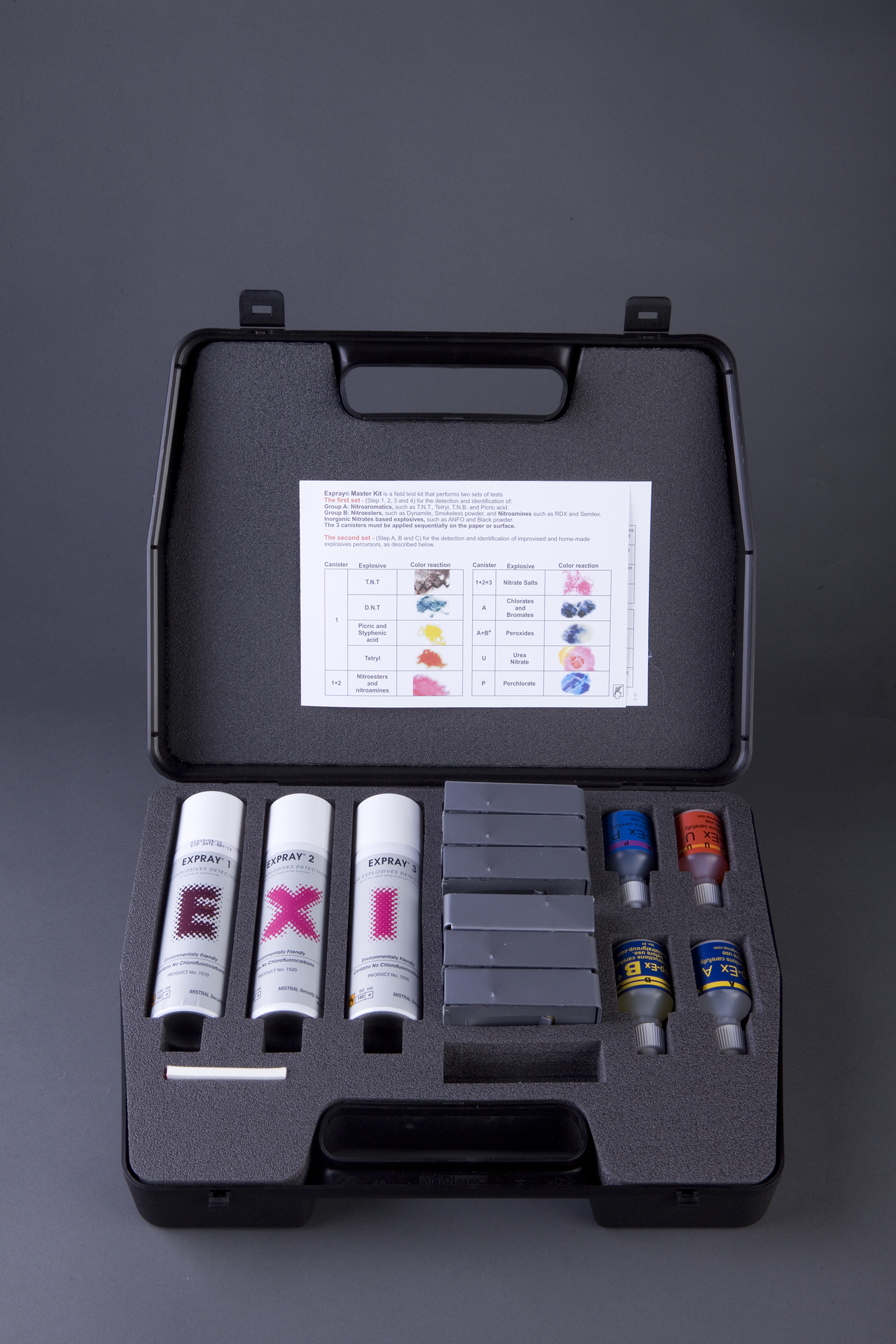
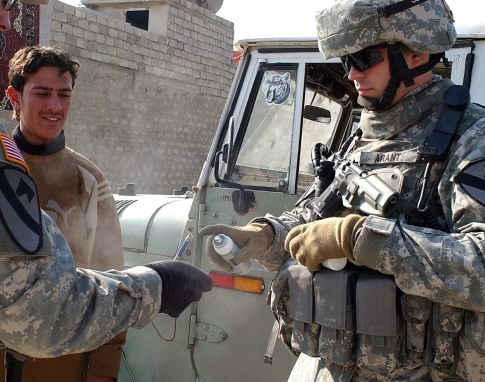
    The EXPRAY explosive detection system is user-friendly, field ready, and portable bomb detection kit. Many military units who deploy to Africa, Iraq, and Afghanistan use this kit to check to see if people have handled bombs, improvised explosive device (IED), and other munitions.

    The kit is in the class of chemical reaction detection. It is a hand held system and allows for a variety of cargoes and people. It consists of a kit with three spray cans where each spray reacts to different types of explosives. It only takes less than a minute to test, only ways about 2 pounds, requires no power, and has a very long shelf life. Troops in the field should bring this kit with them in their vehicles and have at least one of these kits at the squad level when dismounted.

    Expray Explosive Detection Kits
    Expray Explosive Detection Kits (Photo Mistral Security)

    This is a list of what each can detects:

    Expray 1 Nitro Aromatics TNT; Picric Acid; Tetryl
    Expray 2 Nitro Esters/Nitramines Nitrocellulose; nitroglycerin; RDX; C4; HMX
    Expray 3 Inorganic Nitrates (Nitrate Salts); Ammonium Nitrate; Urea Nitrate; ANFO; Black Powder

    The cans inside the kit are aerosol-based. The following list are the explosives it will detect:

    • Group A Explosives – TNT, TNB, and similar
    • Group B Explosives – Semtex H, RDX, C4, and similar
    • Compounds containing inorganic nitrates that are used in IEDs like ANFO


    US Marines demonstrate immediate action drills...
    US Marines demonstrate immediate action drills for improvised explosive devices to Spanish Marines (Photo credit: Official U.S. Navy Imagery)

    A few scenerios where the Expray kit can be used:

    1. Your unit is on a mission and there are IEDs identified either under the road with wires hanging out or you see something on the side of the road that is later identified as an EFP (explosively formed perpetrator) or IED. After the unit and civilians are out of harms way, typically the unit will want to identify suspects who may have put the bomb there. One of the techniques is to test possible suspects who were over watching the IED / EFP. This kit would be used to try and identify who the IED triggerman or handler is. Anyone who comes up as having handled explosives would then be further analyzed for information.
    2. Your unit is on patrol and receives sniper fire from a building. You investigate and there are several insurgents apprehended. You test all of the insurgents and they all test positive for explosives. You then include the explosives in their file so they have more evidence against them in court or in the detention process.
    3. Your unit is on patrol and you see a high value target you are looking for. He is talking with a few people. Your unit apprehends the high value target and then you test the other people he was talking to. In addition to other biometric tests, they pass both the biometric check and the Expray explosive detection test. These people are then cleared for release.
    4. You suspect that IEDs may have been built in a bomb-maker’s house. After detaining the bomb maker, your unit tests different walls, rooms, and furniture in the house. One of the rooms comes up positive for explosives. You investigate the room further and find stashes of explosives under the floor board, in the furniture, or in the ceiling.


    There are many ways to used these kits while in combat. The point is they are a must-have. Unless you have some other way to check for explosives, don’t deploy without these Expray kits.

    Some other non-military uses for the Expray:

    • You can use it to certify scrap for disposal
    • You can screen a sample of soil
    • You can prescreen extracts to identify which test should be performed as a follow up (TNT or RDX)
    • Use it as a back up tool for detection of residue or explosives
    • Check suspicious letters and packages
    • Use to check crime scenes
    • Quick screen of suspects
    • Detect explosives on almost all surfaces


    The Expray kits are made by Mistral Security, Inc. out of Bethesda, MD.

  • Ironclad Gloves – a Great Asbestos Glove Replacement for Barrel Changing

    Ironclad Gloves – a Great Asbestos Glove Replacement for Barrel Changing

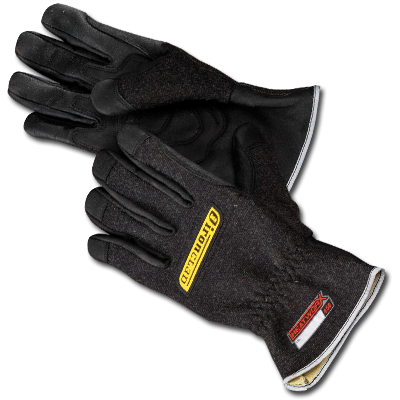
    Ironclad Gloves – Easier and Nicer Looking

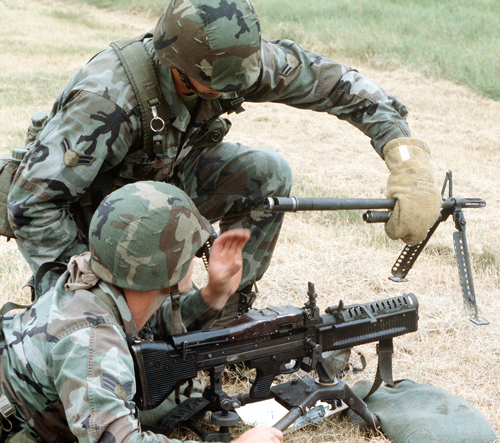
    In the old days, the soldier’s GI issue glove for changing out the barrel of the M240 Machine Gun (and other MGs) was the standard ugly-looking asbestos glove. Also the asbestos gloves of old are often no longer included in the crew served kits because of medical concerns. Units are finding themselves having to buy something else as a commercial off the shelf purchase.

    Barrel Change Asbestos Glove

    After experience in combat and based on military feedback, we have found that the Ironclad Gloves, also known as “Heatworx” are what crew-served weapons teams should use.  Here s a brief summary about why it is better:

    • Needed to replace asbestos gloves no longer included in Crew Weapon kits.
    • Provide essential heat protection and grip for safety during barrel changes on hot weapons.
    • Prevents burn injuries to Soldiers’ hand due to the dangerously unsafe heat created by after minimal firing of weapon.
    • Provides Intermittent Heat Resistance up to 600 Degrees F
    • Padded Knuckles, Full Finger, and 2 3/4 in cuff protection
    • Resistance to heat without sacrificing hand use
    • Breathable and 100% machine washable