The US Army’s New Defense System “High Energy Laser Mobile Demonstrator” Wields its Power
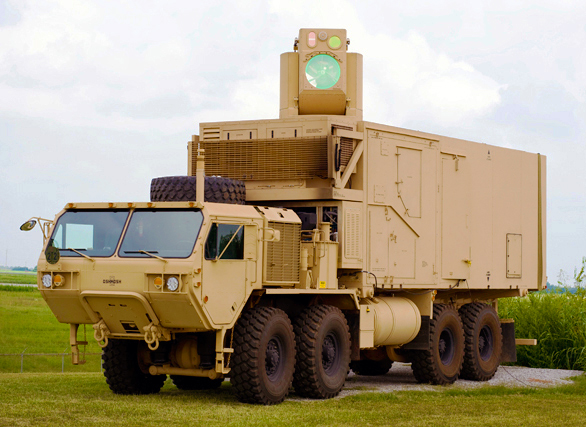
The High Energy Laser Mobile Demonstrator (HEL-MD) is a top-notch laser-based defense weapon being developed by the American Army’s Space and Missile Defense Command, in collaboration with Boeing.
The HEL-MD’s role is to display the potential of directed-energy technology for shielding US Army troops against rockets, artillery and mortars. The first successful trials took place between November 18th and December 10th, 2013 in the White Sands Missile Range, New Mexico. However, the complete integration with a Heavy Expanded Mobility Tactical Truck (HEMTT) was during the summer of 2011, and the first low-power tests of this laser weapon took place during the fall and winter of the same year.
Historical Overview of the HEL-MD
In 1980, US President Ronald Raegan advanced the most prominent propositions for the use of laser guns to destroy flying targets before they could land. The project was called the Strategic Defense Initiative (SDI), which people also referred to as “Star Wars.” However, most of the laser weapon projects were overlooked regardless of the fact that the strategic missile defense concept has never ceased to exist.
Boeing, on the other hand, continued working on the concept, and in February 2010, the company successfully tested one of its Directed-Energy weapons.

How Does the HEL MD Compare to Other Defense Systems?
The HEL MD is not the first defensive system that the US army devised in order to defend the American operating bases with laser weapons in Iraq and Afghanistan. Similar systems include the Boeing YAL-1 Airborne Laser Testbed and the Phalanx-based Counter Rocket, Artillery and Mortar (C-RAM).
Unlike the HEL MD, the defense system known as the Boeing YAL-1 Airborne Laser Testbed was mounted inside a modified Boeing 747-400F and was, therefore, not mounted on a ground vehicle. However, due to some test failures, the funding for this system was cut in 2010, before the US Army decided to cancel the whole system in 2011.
C-RAM, on the other hand, proved efficient to some extent. The system successfully detected and destroyed rockets, artillery and mortars. Nonetheless, some attacks in both Iraq and Afghanistan still succeeded to get through, which is not the case with the HEL MD system as proved during testing in 2012 and 2014.
Another area where HEL MD outperforms C-RAM is the number of rounds in the magazine. The HEL MD system has a “near-infinite magazine” because it is a laser, unlike C-RAM that has a finite number of rounds.
Blaine Beardsley, HEL MD program manager at Boeing, explained, “Even while you’re utilizing the magazine and engaging targets, you’re charging that magazine.” Therefore, unlike its counterparts, the HEL MD laser gun uses electrical power to produce lethal effects. Mark Gunzinger, a Senior Fellow at the Center for Strategic and Budgetary Assessments (CSBA), further illustrated this when he said, “As long as they have a source of electricity and cooling, they can keep firing.”
Furthermore, this laser weapon enjoys the very useful attribution of mobility, hence the name “MOBILE Demonstrator.” In this regard Beardsley added, “You can drive it out to any location and emplace it quickly and be able to set it up with full 360-degree coverage.”

Capabilities and Specifications of the HEL MD
The latest tests of this laser weapon by the US Army in New Mexico are considered to be the first successful demonstration of the capabilities of the HEL-MD mounted on a Heavy Expanded Mobility Tactical Truck (HEMTT). The current system uses a 10-kilowatt laser. However, the system’s power is expected to be upgraded to 50 or 60-kilowatt laser. Later, the laser will be increased to 100-Kilowatts.
In addition to the tests in New Mexico, the system was tested again on 4 September 2014 at the Eglin Air Force Base in Florida. The HEL MD proved very successful even in maritime conditions. The defense system successfully managed to target a variety of aerial targets, even under windy, rainy and foggy weather conditions.
When commenting on this success, Dave DeYoung, Boeing Directed Energy Systems director, said, “As proven at White Sands Missile Range in New Mexico in 2013 and at Eglin Air Force Base this spring, HEL MD is reliable and capable of consistently acquiring, tracking and engaging a variety of targets in different environments, demonstrating the potential military utility of directed energy systems”.
Although other systems such as C-RAM have proven their reliability, the latest trials of the HEL MD laser weapon system by the US Army in Florida helped the system gain a considerable margin over all of its competitors.
What follows is a brief summary of some of the specifications of the current HEL MD defense system:
Current System’s Specifications
HEMTT – 500 hp Caterpillar C-15 engine, Allison 4500 SP/5-speed automatic transmission, 8X8 axle, 16ton payload capacity
Laser – 10 kW tailored commercial laser
BCS – 50 cm aperture retracting telescope, 300 W target illuminator, low jitter precise pointing tracking system
Acquisition & Track Sensors – IR based WFOV for target acquisition coupled with NFOV for engagement
WMI – For a control of the entire system-based on a standard air defense and Avenger C4I interface
BMC4I – Modular design to enable the interface with current and future fielded BMC4I systems
Electrical Power – One set of lithium ion batteries to provide extremely stable power to the laser. Battery charging and another subsystem power from single 60 kW diesel generator, mounted on HEMTT
Thermal Management – Two-loop chilled water system for the laser and standard air conditioner for all other subsystems
Future Plans
Though the current primary use for the HEL MD laser gun system is for the US Army, plans include using this laser defense system to protect the planet from asteroids. There has been a drastic rise in the interest of using this technology since an asteroid hit Central Russia on February 15, 2013. The incident injured more than 1,000 people, which experts regarded as a serious warning about the need for a defensive system that would protect the Earth from any similar asteroid attacks.
Final Analysis
The (HEL MD) laser weapon system has gained fame as a revolutionary defense system for the US Army. It is the only system that proved successful even under foggy, rainy and in maritime conditions. Hence, although other systems like C-RAM will not cease to exist, it is doubtless that the US Army’s New Defense System, the High Energy Laser Mobile Demonstrator HEL MD, will constitute a threshold for more sophisticated directed-energy weapons, especially that those future plans also include saving the planet from asteroids.