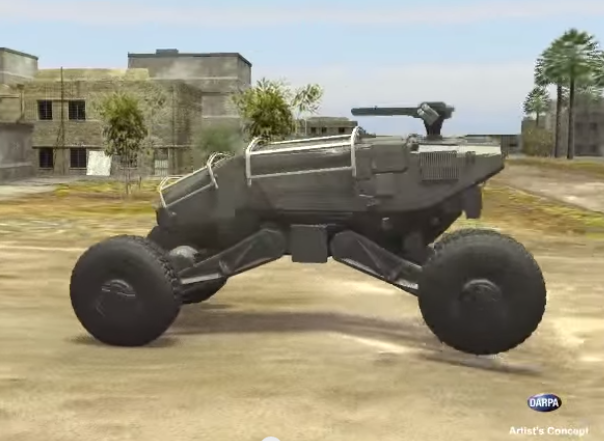
DARPA has been busy with the advancement of Ground X-Vehicle Technology.

There has been a consistent formula which applies to mechanized warfare for at least a century, with regards to the protection of land-based armored vehicles and those who occupy them which is, the more the armor, the more the protection. The difficulty that has developed in the recent years is that with the increased armored protection, there has been an even higher increase in the penetration power of weaponry. As a result, there has been an exponential increase in the armor on such vehicles. This decreases the mobility of these vehicles while at the same time, it shoots up the manufacturing cost. This also restricts the access of such vehicles to roads only, and it becomes next to impossible for them to gain access into restricted spaces.
Size of the Ground X-Vehicle Technology Does Matter
On looking at any US Army armored division, the first thing that one notices is that the tanks are really, really big, and expensive. For instance, a British Challenger 2 weighs 68.9 tons and comes with a price tag of $7 million. There is no escape because, with the increasing power of antitank weapons, the tanks have to be increased in size accordingly. If we take a look back into history, during the First World War, the tanks were no larger than an average-sized SUV. However, over the years, tanks began to get loaded with heavier artillery and more sophisticated armor. To compound matters further, there was a lot of technology being loaded onto these tanks. This resulted in bigger tanks – much bigger.
All this led to the US military taking a closer look at the way armored vehicles are being produced and there was a serious doubt as to whether “The more the armor, the more the protection” was the only solution to the problem. With this in mind, the Defense Advanced Research Projects Agency (DARPA) put into force the Ground X-Vehicle Technology (GXV-T) program for addressing this issue and streamlining the way mechanized warfare is executed. Under the new program, instead of adding on armor, there would be a different approach to resisting and avoiding direct hits on armored vehicles, thus increasing mobility and survivability.

Specifications Ground X-Vehicle Technology
Here is a product that is not quite on the drawing board yet. However the Ground X-Vehicle Technology is being pursued single-mindedly by DARPA. Here is a brief description of the technology that DARPA is trying to implement in the years to come.
The main aim of the Ground X-Vehicle Technology is to produce tanks which are “half as heavy and twice as fast.” The program stresses on agility of the vehicles which should have capabilities of swiftly reacting to an attack by say, shifting the location of armor around within a split second. At the same time it should be able to effect a rapid change in direction in a bid to avoid a direct attack. DARPA also requires that the vehicles should have the capability of literally “dodging” bullets and rockets aimed at them.
The concept of the Ground X-Vehicle Technology program is to entirely remove the dependency on excessive armor once and for all. Kevin Massey, a DARPA program manager cites the example of the X-plane programs where more efficient aircraft was developed but, while at the same time, drastically reducing the size. The GXV-T program aims at manufacturing vehicles which are 50% smaller, thereby reducing the size of the crews and at the same time doubling the speed. These vehicles should be accessible to more than 95% of the terrain, increasing the difficulty in locating and engaging them.
What all this means is that methods have to be devised for producing tanks which are capable of off-road movements, similar to the way rally cars operate, and should be capable of dodging enemy attacks, while at the same time exhibiting stealth properties, shielding them from detection through infrared and electromagnetic sensors. In line with all these requirements, DARPA is hopeful of the emergence of these new GVX-T technologies within two years of awarding the contracts to successful bidders which is scheduled for April 2015.
DARPA Proposers’ Day
The need for bringing in fresh technology to realize the requirements of the Ground X-Vehicle Technology was expressed in the form of “Proposers Day” held on 5 September 2014. The aim of this gathering was to get prospective contractors together at one place, where they could put forth ideas, backed with the related technologies for the development of ground-based vehicles in line with the requirements of the Ground X-Vehicle Technology.
Order of Things to come
With the aggressive campaign of DARPA to create the Ground X-Vehicle Technology, it is going to be interesting to watch and see which way the wind blows. Budgets permitting, it does seem that the US Army is headed for a technological revolution in terms of ground-based vehicles. Although it is early days yet, when the technology finally does come into the field, it will probably change the way land-based army combat operations are executed. Until then, we can only wait and see what emerges with Ground X-Vehicle Technology.
A video of the Ground X-Vehicle Technology concept can be found here: