Tag: Raytheon

Raytheon is a defense contractor firm that specializes in military weaponry and commercial electronics. It also used to engage in aircraft creation but now it is considered to be the largest manufacturer of missiles in the whole world.

Raytheon was established in Cambridge on July 7, 1922, under the name American Appliance Company. The company was created by Vannevar Bush, who would later become Dean of the MIT’s Engineering Department, Laurence Marshall, and Charles Smith. The three came up with the S gas rectifier tube, which eliminated the need for cumbersome batteries that made radios fully functional. This tube made it possible for the radio to be mass-produced and available to every American home. In World War II, the company supplied 80% of the magnetron tubes used in radars and also developed the fuse in antiaircraft shells.

When the war ended, Raytheon moved on to consumer electronics after one of its engineers, Percy Spencer, invented the microwave.

At present, it is headquartered in Waltham, Massachusetts, and provides defense products that include technologies in missile defense, C4ISR, cyber and electronic warfare, and precision weaponry. In recent news, it beat out rivals Northrop Grumman and Lockheed Martin to build a long-range radar system for the US Air Force. The said contract is estimated to cost around $1 billion.

  • ALE-50 Towed Decoy System – The “Little Buddy” of the Skies

    ALE-50 Towed Decoy System – The “Little Buddy” of the Skies

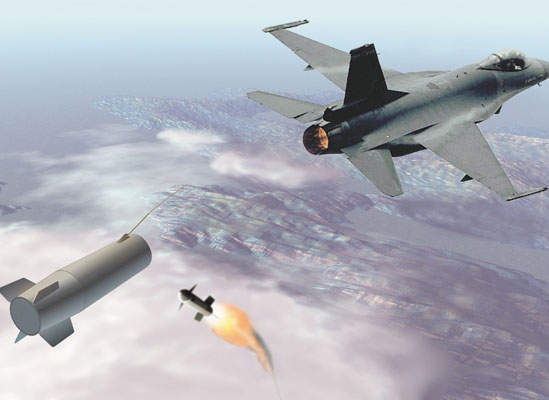
    The ALE-50 Towed Decoy system, also known as “little Buddy,” is a state-of-the-art defense system designed by Raytheon. The main objective of the system is to create an effective countermeasure to defend American aircraft against radar-directed missiles.  This anti-missile countermeasure decoy system is currently used for different U.S. Air Force, Navy, and Marine Corps aircraft, in addition to some other air forces.

    The system has been used in various combats, where the ALE-50 Towed Decoy System successfully demonstrated its effectiveness in thwarting enemy missile attacks. Thus, there is now very little skepticism about what the “Little Buddy” can do.

    Development of the ALE-50 Towed Decoy System

    The ALE-50 Towed Decoy System is the fruit of collaboration of an integrated product team containing experts from Raytheon, the U.S. Air Force, and the U.S. Navy. The team worked on this groundbreaking concept at a Goleta, California facility.

    The first deployment of the system dates back to 1995. Nonetheless, the system is currently used on multiple aircraft that include the F/A-18E/F Super Hornet and the B-1B Lancer. Further, The system has also been incorporated into the innovative ALQ-184(V)9 ECM pod. This integration has helped the system become more vigilant towards threats, and it has also enabled it to be ready to be used on numerous platforms.

    An F/A-18F Super Hornet aircraft assigned to S...
    An F/A-18F Super Hornet aircraft assigned to Strike Fighter Squadron One Zero Two fuels an F/A-18E Super Hornet aircraft from Strike Fighter Squadron Two Seven during exercise Malabar 07-2 while over the Bay of Bengal Sept. 7, 2007. More than 20,000 personnel from five different countries are participating in the multinational exercise that includes naval forces from India, Australia, Japan, Singapore and the United States. (Photo credit: Wikipedia)

    Capabilities

    If the ALE-50 Towed Decoy System has been in service for more than ten years, now, it’s because it has efficaciously demonstrated its wide range of capabilities. When employed, the system shields the aircraft and crew against guided missiles (surface-to-air and air-to-air missiles). The system lures the missile toward a more attractive target and away from the intended one. The decoy that the system utilizes is used when required and cut free before landing. The “Little Buddy” offers the possibility of being operated manually as an independent device. However, it can also be incorporated and controlled by the ALE-47 Airborne Countermeasures Dispenser System (made by BAE Systems).

    In 1999, the ALE-50 Towed Decoy System was tested in Yugoslavia. The results were reportedly very encouraging. Hence, Air Force Officials reported that the system locked down and diverted 10 of 30 surface-to-air missiles that had been fired at B-1 bombers in different parts of Yugoslavia.

    United States Government Accountability Office (GAO) confirmed that planes that have the ALE-50 Towed Decoy System installed in them are more likely to escape fatal enemy attacks. In a report to Congressional Committees in 1997, the GAO expressed its satisfaction regarding how this system improves survivability, and stated that test results indicate the ALE-50 Towed Decoy System, “offers improved effectiveness against radar-controlled threats.” Based on these results, the GAO recommended further use of the system on other platforms such as the F/A-18C/D that the Navy uses.

    As far as the specifications of the ALE-50 Towed Decoy System are concerned, the system is equipped with a launch controller, as well as a launcher that is usually installed on the plane’s wing pylon, in addition to one or more expandable towed decoys, which has a shelf-life of ten years.

    When speaking about the ALE-50 Towed Decoy System, Pat Hurley, vice president and general manager of Raytheon Electronic Warfare Systems, reiterated that, throughout its 50 years of existence, the company has always been concerned with developing its systems in order to provide the military with high-performing products.  In this regard, Hurley added that the permanence of the company’s business and of the ALE-50 Towed Decoy System is a valid testimony to the company’s “high-performing products,” as well as its “laser-like focus on serving the customer.”

    ALE-50 Towed Decoy System – Pricing

    Many experts consider Raytheon to be a leading provider of systems that offer pilots with the most precise information available. With its $22 billion of sales in 2005, the company is also regarded as a leader in defense systems, information technology as well as business and special mission aircraft. The company has a workforce of about 80,000 deployed throughout the world.

    Raytheon manufactures and sells the ALE-50 expendable decoy at $22,000 per unit. In October 2010, the company made a delivery of its latest production run (1,048 units). The total number of units that Raytheon has produced is estimated at 35,000 units, increasing the company’s sales to more than $500 million.

    Soaring OVER THE PACIFIC OCEAN -- A B-1B Lance...
    Soaring OVER THE PACIFIC OCEAN — A B-1B Lancer drops back after air refueling training Sept. 30. The B-1B is deployed to Andersen Air Force Base, Guam, as part of the Pacific Command’s continuous bomber presence in the Asia-Pacific region, enhancing regional security and the United States commitment to the Western Pacific. The B-1 is from the 28th Bomb Wing, Ellsworth AFB, South Dakota.http://www.af.mil/photos/index.asp?galleryID=12&page=2 (Photo credit: Wikipedia)

    Issuance to the Military (Quantities)

    Raytheon has now produced 25,682 units of the system. All of the units have been purchased by the US Department of Defense at a cost of $500 million ($22,000 per unit). The system was initially installed on F-16s only with plans of implementation on other platforms. Therefore, these plans have been carried out systematically and have now been completed successfully. Thus, the “Little Buddy” is currently installed on the B-1B bombers and F/A-18 aircraft.

    In 2005, Raytheon received a production contract from the US Navy and the US Air Force.  In late 2006, The US Air Force granted the manufacturing company a production contract for 862 decoys worth $21 million.

    Use in War:

    The system’s adaptability and reasonable cost enables it to be installed on a variety of aircraft. Thus, the ALE-50 Towed Decoy system now functions on many aircraft such as the F-16, F/A-18E/F, and B-1B aircraft.

    The usefulness of the system has been proven in many situations. ALE-50 Towed Decoy System has shown its capabilities in every major war in which it was deployed. For instance, it considerably helped improve the survivability of aircraft and their crews in places like Kosovo, Afghanistan and Iraq.

    In this regard, Col. Art Huber, commander of the 542nd Combat Sustainment Group at Warner Robins Air Logistics Center, which is in charge of the ALE-50 praised the ALE-50 Towed Decoy System by saying that it is “credited with numerous aircraft saves,” and that “our pilots depend on it.”

    Final Analysis of the ALE-50 Towed Decoy System

    The “Little Buddy” is probably the best countermeasure in use, right now. Tests and actual use in wars have proven its efficacy. The ALE-50’s suitability and interoperability with other B-1B systems when installed in the B-1B bombers have been quite a success. Furthermore, the pricing is very encouraging, and the quality/price ratio has been a determining factor in making the system a must for every aircraft in service. This is why, many pilots who have been to war in different parts of the world have communicated that the ALE-50 Towed Decoy System has been critical in saving them and their aircraft from the dangers of guided missiles.
  • USS Zumwalt Destroyer – The Newest Navy Destroyer

    USS Zumwalt Destroyer – The Newest Navy Destroyer

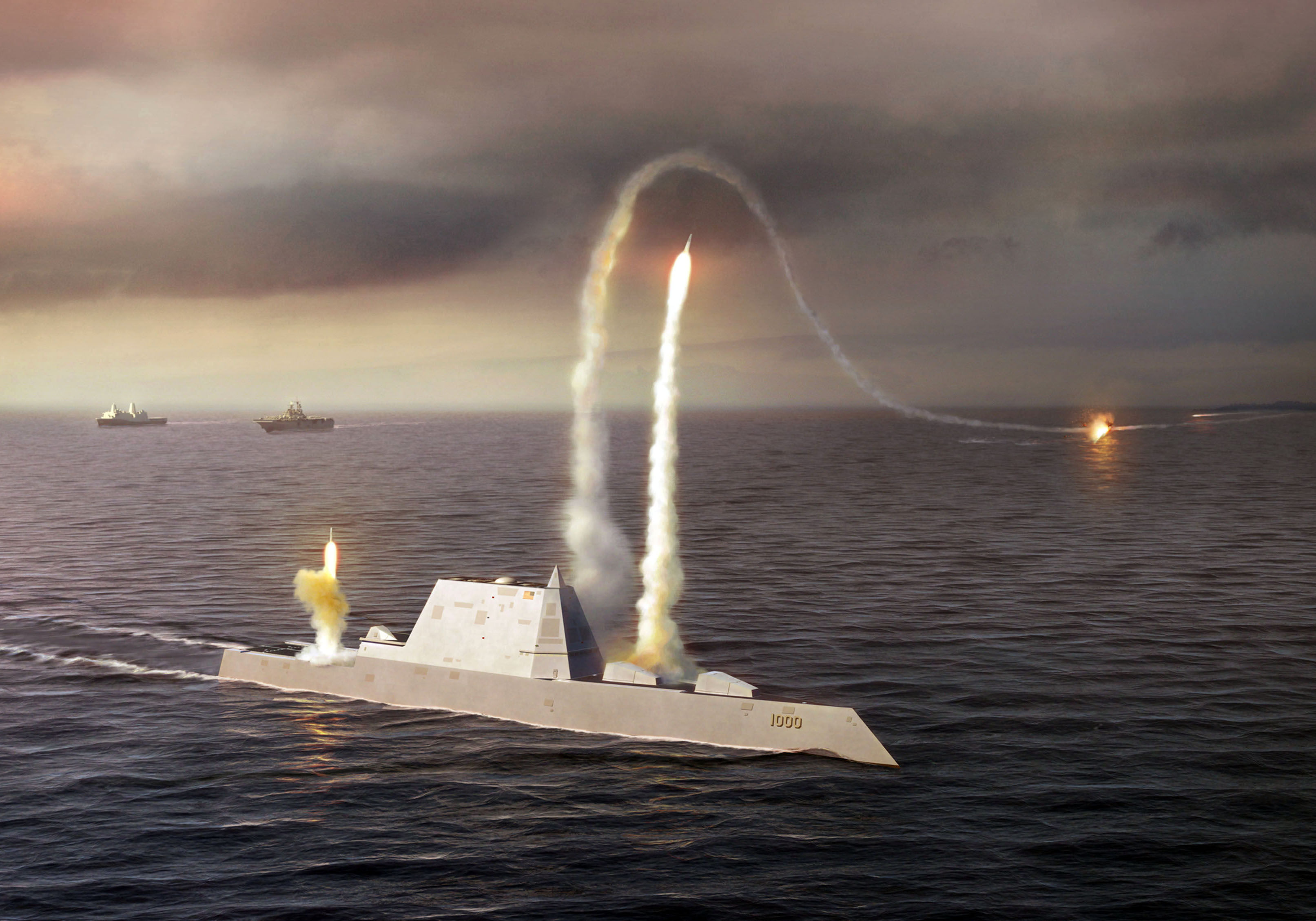
    The latest darling of the US Navy is the USS Zumwalt Destroyer, a force to reckon with and on the top of the list of the US defense arsenal. Named after the renowned Chief of Naval Operations, Elmo Russell Zumwalt, Jr., the USS Zumwalt is the first in line of three such guided missile destroyers.

    The origins of the ship’s basic features date back to 2001, as a result of Congressional defense cutbacks and the subsequent acquisition program. The source of the initial funding came from the National Defense Authorization Act of 2007. The summer of 2008 saw the formation of a construction timetable which was issued to the contractor, General Dynamics with a completion date targeted as March 2015. However, this deadline was later rescheduled to 2014. The first section of the ship was completed by the end of 2011. Despite much speculation about the commissioning being further delayed, the vessel was launched from Bath Iron Works on 29 October 2013.

    More about the USS Zumwalt

    The USS Zumwalt is a DDG-1000 class destroyer and it is one among a total of 3 destroyers of the same class, from the Bath Iron Works, the other two being the Michael Monsoor (DDG 1001) and Lyndon B. Johnson (DDG 1002) which are scheduled to be completed in 2015.

    What makes the USS Zumwalt special is that it is the first of its kind to have some advanced features that were not available with previous ships. Although the bridge is constructed like any other regular ship’s bridge, the Zumwalt is fitted with software that enables the captain to control systems at any location onboard.

    The Zumwalt is also equipped with some of the most advanced radar tracking systems, laser weapons and rail guns and a few gizmos that are still under test by the US Navy. However, the biggest asset of the Zumwalt is its stealth properties. The shielding is designed to make the ship show up as a mere fishing boat on enemy radar!

    Other Special Features

    The Zumwalt is fitted with Raytheon’s Integrated Indersea Warfare sonar, which is built from the type of sonar sensors which are used by sophisticated submarines. The high degree of computerization on board and the high level of automation cuts down manpower requirements drastically. In comparison the 210 sailors required to man an Arleigh-Burke-class destroyer, the USS Zumwalt only requires 130 personnel, with the addition of another 28 for aviation operations. There is a helipad on the ship which accommodates 2 helicopters and a vertical takeoff drone.

    080214-N-0923G-005 WASHINGTON A model of the D...
    080214-N-0923G-005 WASHINGTON A model of the DDG 1000 Zumwalt Class destroyer to be built by Bath Iron Works and Northrop Grumman Shipbuilding is displayed during a contract signing ceremony at the Pentagon. Both companies signed $1.4 billion construction contracts with the Navy as part of the Navy dual lead-ship strategy to introduce the new class of destroyer that will deliver improved warfighting capabilities, continued forward presence and combat power for the surface Navy. ) (Photo credit: Wikipedia)

    Budget Considerations

    As can be well imagined, the cost of all the power and technology that is packed into the USS Zumwalt comes at a price, and a considerable one, at that. Originally, the projected budget of this ship was put at $3.8 billion. However, with all the added developmental costs involved, the original estimate has become inflated to $7 billion. The General Accounting Office initially felt that excessive technology was being pumped into a single vessel, more than required. Due to the huge size of the hull, General Dynamics had to spend $40 million on a building at the Bath Shipyard to accommodate it. It is a well-known fact that originally, 32 Zumwalt-class ships had been planned for, but when the initial estimates came out, this number was hurriedly chiseled down to 24, and the final number ended with just 3.

    English: Zumwalt class destroyer (side view)
    English: Zumwalt class destroyer (side view) (Photo credit: Wikipedia)

    What it means to the US Navy

    The basic objective behind the entire Zumwalt project, although not specifically spelt out by the US Navy, seems to be to show its military presence in the Pacific to counter China’s increasing military power in that area. It is a subtle or maybe not so subtle attempt at maintaining the balance of power in the region.

    Future Plans

    There are no plans to build more than 3 Zumwalt class ships. The US Navy will then revert back to building the traditional Arleigh Burke-class destroyers. It is estimated that even if extensive modernization is applied to these classical vessels, the costs will still be well below those incurred during the Zumwalt-class production line.

    English: PACIFIC OCEAN (Aug. 16, 2009) The Arl...
    English: PACIFIC OCEAN (Aug. 16, 2009) The Arleigh Burke-class guided-missile destroyer USS Mustin (DDG 89) transits the western Pacific Ocean. Mustin is one of seven Arleigh Burke-class destroyers assigned to Destroyer Squadron (DESRON) 15 and operates from Yokosuka, Japan. (U.S. Navy photo by Mass Communication Specialist 2nd Class Bryan Reckard/Released) (Photo credit: Wikipedia)

    Reflections on the Zumwalt

    The USS Zumwalt and the other associated Zumwalt-class destroyers represent a shot in the arm for the US Navy. It is through these vessels that the American military presence can somewhat renew its strength. Here is a vessel which has a lot of power packed into its punch, and enough technology added to make the force of the US Navy felt. However, this class of Navy vessel cannot be sustained indefinitely in the cash-strapped American economy. A balance has to be struck at some point. We have seen the birth of the USS Zumwalt, but how sure can we be about the emergence of the remaining two ships? What can be confirmed however is that the USS Zumwalt is here to stay. It continues to be a proud feather in the cap of the US navy.

    Sources:

    Press Herald
    Global Security
    CBS News