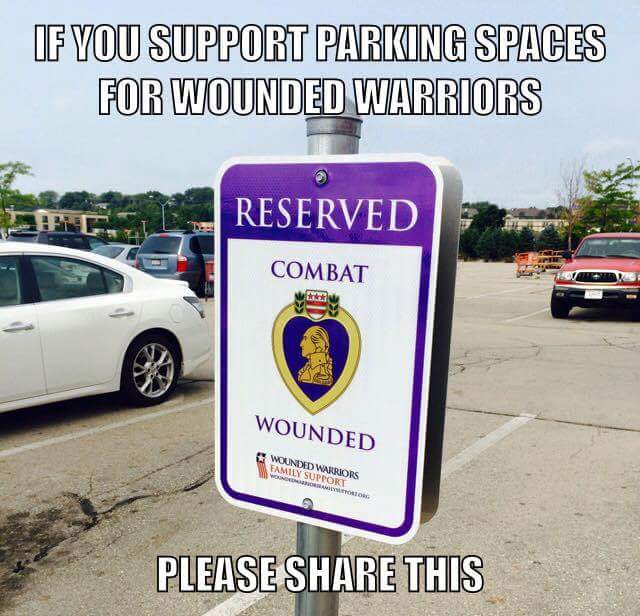
It is always heartening to see a movement happening to recognize the value of some of America’s very special citizens, and this great nation seems to be stepping forward in yet another campaign, this time in the form of parking space for combat wounded vets. The concept is not all that new – the Wounded Warriors Family Support (WWFS) based in Nebraska, initiated this movement in 2012, and it has been picking up momentum, slowly but steadily. This group has many activities related to the welfare of combat wounded vets. The campaign for providing parking space for combat wounded vets is yet another initiative of the WWFS. The group supplies these aluminum parking signs that say “combat wounded” to establishments who show interest in erecting these signs.
The procedure for procuring these signs is quite simple – an email needs to be sent to the WWFS, and it is possible to apply online. Only the shipping and installation costs need to be borne by the establishments, and the signs should be installed in line with local guidelines for handicapped parking signs and should comply with the rules of the Department of Transportation. The distinguishing feature of these parking spots is that purple is used for the boundary line and on the actual signboard, which reflects the color of the Purple Heart which the occupants of these parking spaces would normally be in possession of.
Am I Eligible?
Being eligible for parking space for combat wounded vets means that the person should meet the basic criteria of a U.S. soldier who has received some form of disability which falls into the category of a combat-related injury, but there are a few other preconditions that need to be met to be an official combat wounded vet. The individual is usually a recipient of the Purple Heart, but would also need to be in possession of documentation to prove that they have received injuries through armed conflict, simulation war, hazardous service, Agent Orange, mustard gas or Lewisite (yes, they’re still using this out there!) or Gulf War. Under such circumstances, a person is usually likely to have disability plates, which should be sufficient enough to prove eligibility.
Not all disabilities are visible. A wounded veteran doesn’t only mean a missing limb. There are other less-obvious and sometimes invisible. For instance, a person may have impaired vision, deafness or the something common to many soldiers who have been in active combat – Post Traumatic Stress Disorder (PTSD). This aspect is not always understood by many civilians, as in the case of Johanna Thompson of WGU Washington:
“Today I was accosted by a woman in a walmart parking lot for parking in the wounded warrior parking space, I am a service connected disabled veteran. My husband is also. As I parked a woman ran at me accusing me of being a traitor to my country for parking in that spot. I have disabled plates, but she questioned my military service and whether or not my disabilities were service connected. In the end this crazy woman threatened to get a gun and wound me herself. People need to understand that not all disabled veterans are missing a limb, some of us have injuries you cannot see, like TBI, extreme deafness, PTSD. People if you see someone park in a spot don’t rush to judgment. This woman had me in tears, I served my country and gave a lot, my health, my future and my ability to live the life that I wanted.”
Where can I find them?
Since their launch in 2012, these signs have mushroomed all over the country, in the parking lots of businesses, churches, schools and colleges, government, and medical facilities. More recently, Wal-Mart and Home Depot have actively participated in the program by installing these signs in their parking spaces. A spokesman for the Home Depot stated that these signs have been installed in their entire northern region locations.
The program for parking space for combat wounded vets is a voluntary one, and it is not yet ratified by an act of Congress. Nevertheless, the response to the program has been positive, with several organizations applying to the WWFS for these signs since 2012.
Charlotte County, Florida received forty signs in 2013. County Veteran Services Officer David Donohew said, “It’s a new program for us, and we are the first in Florida to have these signs…We want to make sure that when they [Combat Wounded Veterans] utilize county services, that it’s as easy as possible for them.”
Also in Florida, in Citrus County, in November 2015, combat wounded parking signs have been installed at Lecanto Government Building, the Citrus County Courthouse, and West Citrus Government Center. The move was initiated by students of Lecanto Middle School who made a presentation to the Board of County Commissioners, and the kids even managed to get sponsors for shipping and installing the parking signs.
Also this month, in the city of Warren, Ohio, the municipal court has had a parking space for combat wounded vets installed. It’s the first of its kind in Warren, but there are now plans to put one in every building, according to city officials.
Other cities where these parking spaces have now been established are Sugarland, Danvers, Massachusetts and Temecula, and in various locations in the states of Georgia, South Carolina and Texas.
Opinions
As is the case with all new programs, there is always a lot of discussion and opinions that get exchanged, and these purple parking spaces are no exception. There are people who are not in favor of them, and then there are those who are.
Veteran, Major Derek J Plymate, from Las Vegas, Nevada, who has served with the US Armed Forces for 20 years, is modest about his sacrifice as a wounded warrior. Major Plymate feels that his status is no greater than a fireman or police officer, wounded in the line of duty. “We all protect and serve in different ways”, he says.
The feeling about these parking spaces mostly seems to be positive, however. Stuart Thompson from Georgia feels that instead of complaining, people should just be thankful to organizations like Home Depot and Wal-Mart for promoting this program.
Engineer Daniel Baca is also all for the purple parking space, and he says that there are more and more of these spaces appearing where he lives.
Lt. Col. Mike Lovett (Retd.) from Charleston, South Carolina is also all praise for them and says that he was thrilled to find one at a Harris Teeter that he had visited at the Isle of Palm.
Conclusion
There are a few naysayers who are not in favor, but the general opinion of people, especially veterans who are best-qualified to comment, are all for this program. The purple parking spaces are definitely proliferating, thanks to the efforts of the WWFS and the organizations that are actively participating in the program, so, it is likely that we will be seeing more and more parking space for combat wounded vets in the near future.