Tag: MQ-1 Predator

  • RQ-170 Sentinel Drone – The US Air Force’s Stealth Drone

    RQ-170 Sentinel Drone – The US Air Force’s Stealth Drone

    History

    The US Air Force and the Pentagon have been pursuing their drone development program since 1995, the most prominent drone series being the Predator series (A, B & C). Today, it is a full-fledged operation. One of the latest projects now being pursued is the US Air Force’s RQ-170 Sentinel Drone, manufactured by Lockheed Martin. The US Air Force has not released much information about this drone. However, this US drone is known to be a stealth aircraft, fitted with reconnaissance equipment for the purpose of gathering data from non-cooperative countries such as Iran, Iraq and Afghanistan. It is being used since 2011, when it was launched during the ongoing war in Afghanistan, called “Operation Enduring Freedom”.

    It is also worthwhile to note that this US drone was used quite effectively for tracking down Osama Bin Laden, the mastermind of the 9/11 attacks. The system is believed to have been set up in the Pakistani town of Abbottabad where the terrorist was believed to have been hiding, in a heavily guarded compound, with the full knowledge of the Pakistani authorities. It was through the data fed to the Navy SEALs from the Sentinel system that they were able to penetrate the compound and terminate this dreaded terrorist on the spot.

    The RQ-170 Sentinel has also been used in South Korean airspace, which would have been obviously for the purpose of spying on activities in North Korea.

    Lockheed Martin RQ-170 Sentinel
    Lockheed Martin RQ-170 Sentinel (Photo credit: Wikipedia)

    Duplication of the Sentinel

    In December 2011, an RQ-170 Sentinel was sent into Iran on a reconnaissance mission. The Iranian armed forces intercepted the drone and hacked into its navigation systems, managing to capture it. They claimed that they had been able to duplicate it by decoding the software and using reverse engineering. Although, the claims were stated as being fake by a former Pentagon official, the Iranians stuck to their story and showed video footage of the drone.

    The landing gear, however, was covered by a banner stating, “We’ll trample America underfoot” and “the US cannot do a damn thing.”

    The RQ-170 Sentinel has also been copied by the Chinese who released pictures of the copied drone along with some other aircraft.

    Specifications

    The specifications the US drone described here are not official, as there are no official documents available, due to the highly classified nature of the RQ-170 Sentinel project, as it is being kept under wraps by the CIA and the Pentagon. However, what has been reproduced here, are as accurately-possible facts, which should give a fair picture about the Sentinel and its capabilities.

    The RQ-170 Sentinel by Lockheed Martin is a rather new addition to the United States Air Force’s fleet of Unmanned Aerial Vehicles (UAVs). It is a stealth vehicle, which is supposed to be a cost-effective drone with added qualities put on to existing design features. The purpose of the Sentinel is for surveillance and reconnaissance of enemy territories from a high altitude. The drone is mostly connected to CIA missions, which is the reason most of the information on it remains classified by the Pentagon and unavailable to the general public.

    A B-2 Spirit soars after a refueling mission o...
    A B-2 Spirit soars after a refueling mission over the Pacific Ocean on Tuesday, May 30, 2006. The B-2, from the 509th Bomb Wing at Whiteman Air Force Base, Mo., is part of a continuous bomber presence in the Asia-Pacific region. (U.S. Air Force photo/Staff Sgt. Bennie J. Davis III) (Photo credit: Wikipedia)

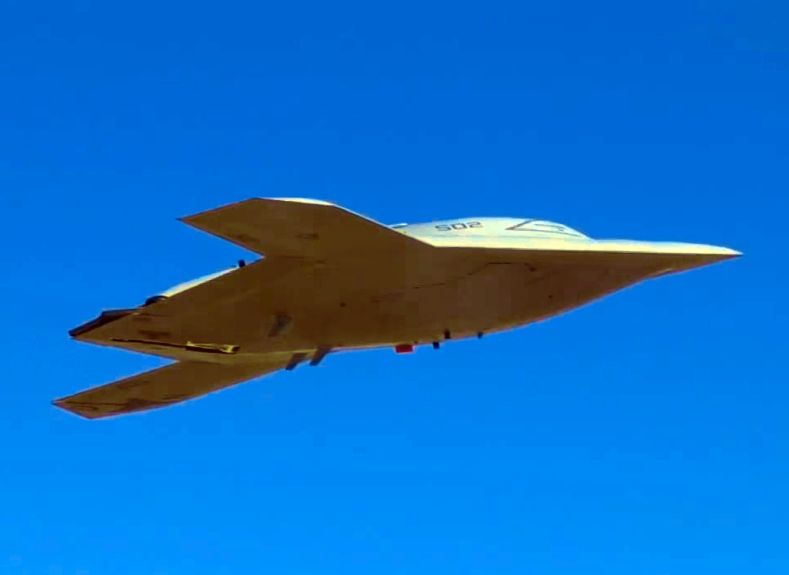
    Looks-wise, the Sentinel is more of wing, with less of vertical tail surfaces. The wing structures are swept towards the rear of the aircraft, giving it the appearance of the B-2 Spirit Stealth Bomber. It is powered by a single General Electric TF34 series turbofan engine. The payload region is also located in the central area. The abundant wings serve the purpose of offering extra fuel storage. The undercarriage is in a regular tricycle configuration with two main landing wheels and a single landing gear in the nose section.

    The aircraft is equipped with a full suite of cameras and sensors. There are full motion real-time cameras and radioactive isotope-detecting sensors for locating nuclear material. It is assumed that the drone is also armed with missiles, in the same way that the Predator is. It is also understood to have the latest infra-red and other optical devices fitted.

    The maximum altitude observed by this drone is at least 50,000 feet. The wingspan is estimated at 26 meters, with a height of 1.84 meters and a length of 4.5 meters.

    Future Prospects of the Sentinel

    It would seem that the Sentinel has had a rather big setback with the copying of its design by the Iranians. Although there is no information forthcoming from the Department of Defense, the Pentagon, US Air Force or the CIA, there is no dearth of information emanating from Iran regarding the Sentinel and future plans. RT.com News published an article in May 2014 quotes a statement made by Iranian leaders who said that their engineers have managed to decode the drone’s technology and copy it. There will soon be a test flight, they promised.

    From what we see, the RQ-170 Sentinel is definitely here to stay, but if the US military is to keep the technology to itself, it is going to have to figure out how to keep its classified secrets from falling into enemy hands, as has been the case in the recent past.


  • MQ-9 Reaper Drone – Death from Above

    MQ-9 Reaper Drone – Death from Above

    Before we get into the specifics of the MQ-9 Reaper Drone, one of the deadliest drones in the US arsenal, we must first cover some history.

    History of the Drone

    A third of the US Air Force’s aircraft is estimated to comprise of drones today. The concept of drones is not a new one. The history of drones or Unmanned Aerial Vehicles (UAVs) dates back to the 1930s with the development of the “Queen Bee” by the British Royal Navy. However, it was not until 1995, that concerted efforts were commenced by the United States to develop drones for military applications. The MQ-1 Predator (Predator A) was first put into use in 1995. It began as a surveillance vehicle and data gatherer, but was later fitted with Hellfire Missiles, for targeting suspected terrorists. It was created as a result of a directive from the Department of Defense for counter-insurgency measures at overseas locations.

    Reasons for MQ-9 Reaper Drone Development

    As a result of the war with Iraq, and in the aftermath of the 9/11 attacks, a need was felt to step up counter-terrorist measures by the US armed forces. The ongoing war with Afghanistan also reinforced this conviction. In 2007, the first test flights of the MQ-9 Reaper Drone were carried out at the Creech Air Force Base in Nevada. This new series of drones was first pressed into service in actual combat in Iraq and Afghanistan later during the same year. This was followed by successful missions in other countries like Ethiopia and Libya.

    English: An MQ-9 Reaper unmanned aerial vehicl...
    English: An MQ-9 Reaper unmanned aerial vehicle flies a combat mission over southern Afghanistan. (Photo credit: Wikipedia)

    MQ-9 Reaper Drone Technical Specifications

    The MQ-9 Reaper Drone (Predator B) was developed as an improvement to the MQ-1 Predator (Predator A). It is bigger and better than the MQ-1 Predator in terms of power and munitions delivery. The codification of the drone is as follows: “M” stands for Mulirole, “Q” for Unmanned Aerial Vehicle and “9” is the series designation.3

    This drone is described as an armed drone of medium, multi-mission, medium-altitude capabilities. Its primary function is that of intelligence collection and the secondary function is attack on dynamic execution targets.

    The MQ-9 Reaper is totally remote-controlled. It is fitted with a Multi-Spectral Targeted System, consisting of visual, infra-red and laser sensors. The munitions system is also laser-guided.  The suite of functions that the Reaper can perform is surveillance, reconnaissance, precision strike, search and rescue during combat, convoy/raid over-watch, air support, buddy-laser, and terminal air guidance, development of targets and clearance of routes. The aircraft is fully-equipped with sensors and weapons with a satellite link between the drone and the ground control station. The entire aircraft can be dismantled and transported in a C-17 transporter or larger, but is also capable of independent taking off and landing from a standard US airfield.

    Here is a summary of some of the specifications of the MQ-9 Reaper:

    Specifications

    Primary Function  Intelligence collection & reconnaissance
    Contractor General Atomics Aeronautical Systems, Inc.
    Power plant  Honeywell TPE331-10GD turboprop engine
    Thrust 900 shaft horsepower
    Wingspan  66 feet (20.1 meters)
    Length 36 feet (11 meters)
    Height  12.5 feet (3.8 meters)
    Weight 4,900 pounds (2,223 kilograms) empty
    Fuel Capacity 10,500 pounds (4,760 kilograms)
    Payload  4,000 pounds (602 gallons)
    Speed 3,750 pounds (1,701 kilograms)
    Range  Cruise speed approx. 230 mph
    Ceiling 1,150 miles (1,000 nautical miles)
    Armament Up to 50,000 feet (15,240 meters)
    Crew AGM-114 Hellfire missiles, GBU-12 Paveway II and GBU-38 Joint Direct Attack Munitions
    Unit Cost $56.5 million (4 aircraft with associated equipment)

    Other MQ-9 Reaper Drone Buyers

    The primary customer of the MQ-9 Reaper is the US Air Force and the US Government. However, the sale of this drone is not restricted to the US alone. In 2011, the US Department of Defense signed a contract with General Atomics Aeronautical Systems to supply 24 extra systems of the MQ-9 Reaper to the Italian Air Force. The total value of the contract was tagged at $15,053,926.

    In 2013, the Netherlands declared that it would be acquiring its own fleet of Reapers by the year 2017, amounting to 4. Today, France and the UK are also using MQ-9 Reapers, making this drone a global product.

    MQ-9 Reaper
    MQ-9 Reaper (Photo credit: Wikipedia)

    Future Plans of the MQ-9 Reaper Drone

    The MQ-9 Reaper has had a good tour of duty. However, it is likely to be replaced by the next generation of drones. The Army is now developing the successor to the Reaper – the Avenger (Predator – C), a sleeker and more robust design, compared to the Reaper. The main features which differentiate the Avenger from the Reaper is that the Avenger is jet-propelled and it is has stealth properties and the cruise speed is double that of the Reaper.

    MQ-9 Reaper Drone Final Analysis

    If we consider the track record of the MQ-9 Reaper, it would be fair to say that it has had a fairly successful journey. One thing is sure, and that is, unmanned aircraft will play a prominent role in the US Air Force in the future years. When Secretary of Defense, Robert M Gates addressed the Air Force Academy in 2011, he mentioned that although there will always be a need for manned flight in the US military, there is a great scope for the development of remotely piloted vehicles, for reconnaissance and strike. “I see no excuse for men in fighter planes to shoot down bombers,” he says, “The next Air Force is going to be built around scientists.”

    It appears the MQ-9 Reaper Drone will continue to see heavy use for many years to come, until such a time as it is fully replaced by the Predator 3 and future models.