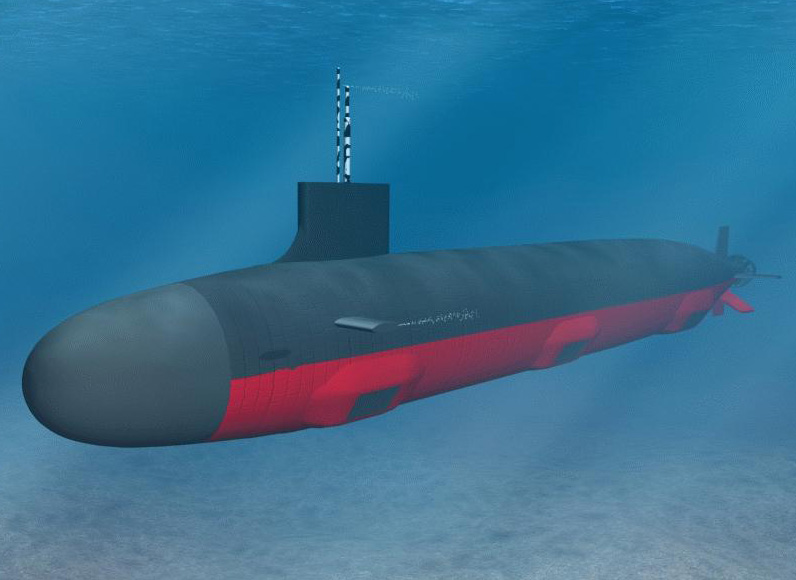
In April 2014, the US Navy made public its latest intention to contract 10 new submarines (the Virginia Class submarine). This contract consists of Block III of the 3-block supply schedule. Blocks I and II have already been delivered. The total value of the contract is estimated to be $17.645 billion. The model is SSN 774 Virginia-class, and they are nuclear power attack submarines. The contract has been awarded to two companies – General Dynamics Electric Boat and Huntington Ingalls Newport News Shipbuilding. The supply will commence in 2018, with two subs each year, one from each yard, for a period of 5 years, until the year 2023.

Impact of the Contract
This contract has literally created waves in the Navy and shipbuilding circles. Financially, it is considered the biggest contract ever to be awarded in the history of the US Navy. Rear Adm. Dave Johnson who is the executive officer for submarines at Naval Sea Command (NAVSEA) is all praise for the contract. He says that it reinforces a solid relationship between the Navy and industry as far as the Virginia-Class program is concerned. He has called this program “a model of acquisition excellence.”
Shipbuilders also had their say by stating that it is the largest contract till date in terms of number of boats ordered in a single contract, which is especially unique in today’s scenario, considering the current economic and political situation. The president of the Electric Boat, Jeffrey Geiger, says that if they are able to supply two ships a year, it will greatly enhance the US Navy’s undersea dominance.
The hull numbers are designated SSN 792 to SSN 801, but these submarines have not yet been named. The US Navy already has 10 Virginia-class submarines. There are another eight in the process of being built. Almost all contracts for Virginia-class subs have been awarded on the basis of multiyear contracts which creating cost-efficiency in the long run.

Specifications and Costs of the Virginia Class Submarine
Although the amount quoted in the contract is for $17,645,580,644, there are options for on-board repair parts, so the total value of the contract could touch $17,827,808,738.
Even though some foreign competitors had more sophisticated models in their proposals; these 10 Virginia-class submarines will basically contain all the existing features of this class, but with some new ones added on. Incremental integration of new technologies will be added to the main structure.
Submerged, each sub displaces 7,800 tons. The hull is 377 feet long and 34 feet in diameter. The submarines will be able to reach speeds in excess of 25 knots and the diving depth will be over 800 feet. Each submarine will carry Mark 48 advanced capability torpedoes, along with Tomahawk missiles and also unmanned underwater vehicles.
So, let us take a closer look at the specs of the Virginia-class Submarines of the US Navy. In addition to the points mentioned above, the hull has structurally integrated enclosures. Designed for easy repair, maintenance and upgrade. It has modular deck structures, which makes it easy to install and maintain. The diving control and steering of the submarine is accessed through a joystick of 4 buttons and a double axis. Being a stealth vessel, the submarine has a low acoustic signature which is achieved through anechoic coatings and a specially-modified engine.

What’s New in the Block III Submarines?
One major difference in the Block III submarines is in the payload tubes. They are designed to reduce cost and at the same time, increase the scope of missile-firing capabilities. Up till now, a Virginia Class submarine has 12 separate vertical launch tubes with a diameter of 21 inches for firing Tomahawk missiles. The Block III submarines, however, have only two tubes of 87 inches in diameter, where each tube has the capability of launching 6 Tomahawk missiles.
Although the main motivation behind the modification of the launch tubes is cost-reduction, it also increases the possibility of future missiles and launching of off-board sensors from these tubes. The Virginia Class Submarines also have the special characteristic of fly-by-wire technology, where the entire controls are computerized, and the submarines are driven by the touch of a button or touchscreen controls. This is unlike the earlier versions of submarines which used to run on mechanized hydraulics.
The Large Aperture Bow array of the Block III submarines also establishes an advanced sonar system in the boat’s bow, known as the conformal sonar system.3
The LAB array is an improvement over the previous spherical arrays which enable enhanced passive listening capabilities. There is also a medium-frequency active array added to the LAB array. The hydrophones are based on previous designs and serve the usual functions of either locating active reflected sounds or incoming passive sounds.

Future Plans for the Virginia Class Submarine
The US Navy has great plans on the anvil, and the Block III submarines are likely to receive the new technology as it is handed out. There is talk of the development of futuristic weapons by the US Navy like Laser weapons, which are being currently tested in the Persian Gulf and electromagnetic rail guns which uses electromagnetic force to send a missile over a long range at mind-boggling speeds. The Virginia Class Submarine will change the way undersea battles are fought.