Tag: Class II Expendables Equipment Kits Tools

Class II is the second among the ten classes of supply that the United States Armed Forces has made as a part of their supply management plan. Class II is also one of the five classes that NATO uses. This class of supply contains expendables such as individual equipment, clothing, tentage, maps, hand tools, organizational tool kits and tool sets and housekeeping as well as administrative equipments and supplies. Class II items are marked with the symbol of a key and belong to the consumer class of troops.

 There are several subclasses of class II items. These subclasses are A, B, E, F, G, M and T.  As subclass A deals with aviation and aircraft related supplies, those class II items that are needed for aviation and aircraft oriented purposes belong to this subclass. Ground support materials belonging to class II, fall under subclass B. Among other subclasses of class II items, Subclass E contains general supplies, subclass F contains clothing, subclass G contains electronics items, Subclass M contains weapons and class T contains those class II supplies that are needed for industrial purposes.

  • New Army Uniform Getting Rolled Out

    New Army Uniform Getting Rolled Out

    The Old and the New

    The latest buzz going around in US Army circles is about the new army uniforms, the Operational Camouflage Pattern (OCP), which are in the process of being rolled out; the entire conversion to the new uniform is expected to be completed by the summer of 2018. In 2004, the US Army decided to scrap the two versions of uniforms, to be replaced by a standardized model called the Army Combat Uniform (ACU). The cost of this conversion was $5 billion. The budget for the OCP has been estimated at $4 billion. According the army’s plan, the new uniform will be available in stores from next summer, and soldiers will have to replace their worn-out uniforms with the new ones.

    The Battle Dress Uniform (BDU)

    From the 1980s to the mid-2000s, this uniform was used by the US Army. This uniform is basically in shades for jungle camouflage, using olive green, tan and brown. It is similar to the type of uniform that was used during the Vietnam Era. These uniforms are also called ‘temperate weight uniforms’.

    There existed several variations of the BDU such as ‘tropical weight’ BDU composed of 100% cotton rip-stop poplin cloth. Other BDU variants are the ‘temperate weather’ BDU, ‘hot weather BDU and the ‘enhanced hot weather’ BDU. The main feature that distinguishes each variation is the ratio of synthetic fiber to cotton fiber.

    The Shortfalls of the ACUs

    The ACUs were beset with flaws from the very start. In an attempt to modernize the uniform, an excessive amount of Velcro was used. In a combat situation where absolute silence is required, the Velcro fasteners have a tendency to open with a scraping sound, possibly giving the soldier’s position away to the enemy. Moreover, this Velcro restricts the movement of personnel, especially when brushing against each other with the Velcro strips adhering to each other’s uniforms.

    The color scheme was another bone of contention, as the choice of colors was unsuitable for blending into the environment. Moreover, due to mass production of this uniform, there were several quality issues and the ACUs wore out faster. To put it bluntly, the troops hated the ACUs.

    The Rise and Fall of MultiCam

    In early 2010, a new version of army uniform was introduced known as the ‘MultiCam’ uniform. This was introduced as an interim arrangement, to remedy the flaws that existed in the ACU uniforms. It was intended to be suitable for use under different weather, elevations, light conditions and environmental conditions. MultiCam was a suitable choice for many technical reasons, the main advantage being that it blended well into multiple environments.

    Commercially, the MultiCam uniform was a great choice as the design already existed in the market. This presented a cost-effective solution to the problems of the ACUs, as the huge outlay for creation of a new design was eliminated. Finally, the most relevant reason for the potential success of MultiCam – the troops loved it.

    Unfortunately, it was commercial problems that led to the failure of MultiCam. The army asked the MultiCam manufacturer, Crye Precision, to reduce the licensing fees of the fabric printers, but owner Caleb Crye did not agree to this. The army then offered to buy the manufacturing rights from Crye, but was not willing to pay him the $24.8 million that he asked. This marked the last nail in the coffin of MultiCam, giving birth to the new army uniform which the US Army claims to be “very similar to MultiCam”, although not much is known about it yet. However, recent photographs of the uniform do show a resemblance with the old camouflage pattern of greens, yellows and browns.

    New Army Uniform
    New Army Uniform

    The New Army Uniform

    The new uniform pattern is called ‘Scorpion’. Senior US Army officials have started briefing their staff about it, although the army is playing this one rather close to the chest, possibly due to the flak that it has drawn from frequent and expensive changes in the recent and not so recent past. The new uniform has yet to be announced, but extensive field testing has been carried out over the last 4 to 5 years, using thousands of soldiers as volunteers for measurement of parameters like thermal reflection, level of concealment, comfort of wearing and general wear and tear.

    Release Date

    It appears that there is no official release date for the new Scorpion pattern style uniform. While it is being tested and the logistics are still being worked out, as soon as we know the release date we will post it here.

    The Bottom Line

    Whether the troops like the new army uniform or not, will largely depend on their actual experience from wearing the uniform, and that too, in combat situations. As the old adage goes, “The truth of the pudding is in the eating.” There has been a lot of skepticism in general about the uniform policy of the US Army. Billions of taxpayer’s dollars have been spent, often with little to show, as each version seemed to have its own set of issues, some newer versions being worse than the previous ones (see the ACU). The question that is in everyone’s mind now is as to whether this Catch-22 situation will continue, or will the US Army finally succeed in coming out with a good product that will win the approval of the final users, the soldiers themselves? This is something that remains to be seen (on in this case – hopefully “not seen” since it is supposed to be camouflaged).
  • Classes of Supply – What are they?

    Classes of Supply – What are they?

    The United States Armed Forces uses ten classes of supply. These are ten roman numerals designed to categorize the different types of items one might need on the battlefield. These classes of supply are a great checklist to use when deciding if you need something or not.

    So here is the list of the Army classes of supply directly out of the U.S. Army Field Manual 4-0:

    • Class I Subsistence, including health and welfare items.
    • Class II Clothing, individual equipment, tentage, tool sets and tool kits, hand tools, administrative, and  housekeeping supplies and equipment (including maps). This includes items of equipment, other than major items, prescribed in authorization/allowance tables and items of supply (not including repair parts.
    • Class III POL, petroleum and solid fuels, including bulk and packaged fuels, lubricating oils and lubricants, petroleum specialty products; solid fuels, coal, and related products.
    • Class IV Construction materials, to include installed equipment and all fortification/barrier materials.
    • Class V Ammunition of all types (including chemical, radiological, and special weapons), bombs,
    • explosives, mines, fuses, detonators, pyrotechnics, missiles, rockets, propellants, and other associated items.
    • Class VI Personal demand items (nonmilitary sales items.)
    • Class VII Major items: A final combination of end products which is ready for its intended use: (principal item) for example, launchers, tanks, mobile machine shops, vehicles.
    • Class VIII Medical materiel, including medical peculiar repair parts.
    • Class IX Repair parts and components, including kits, assemblies and subassemblies, reparable and  nonreparable, required for maintenance support of all equipment.
    • Class X Material to support nonmilitary programs; such as, agricultural and economic development, not included in Class 1 through Class 9.


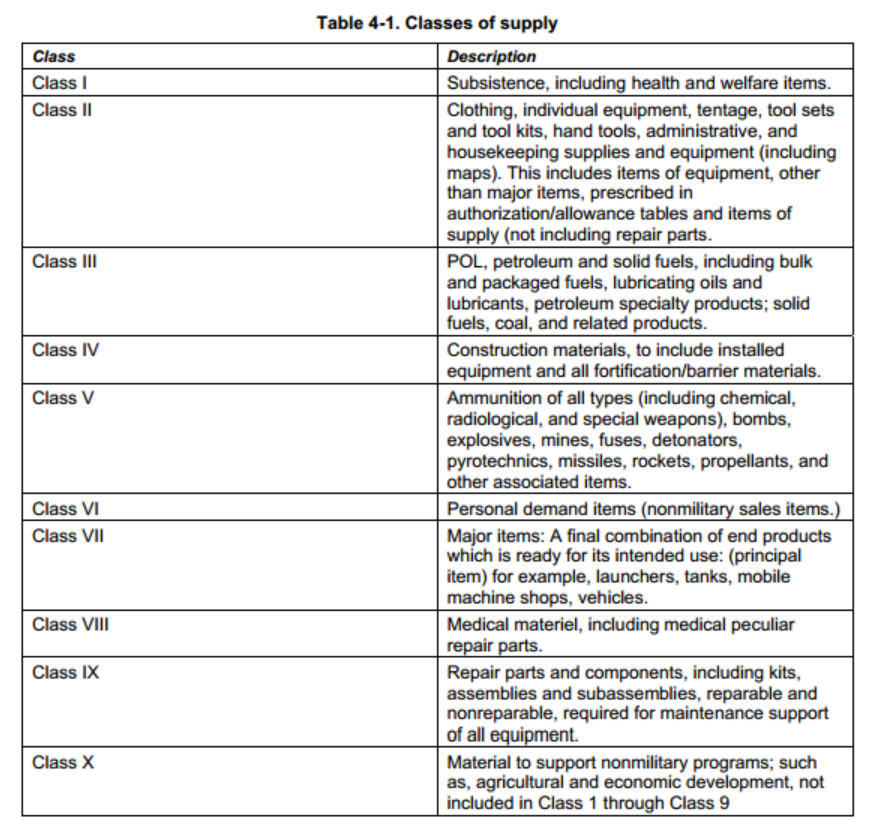
    The above was the text version of it, now we are putting an image of them in case you want to print it out or use the image in a presentation etc. So here is the image:

    Classes of Supply
    Classes of Supply from the Army Field Manual 4-0

    Tips for Classes of Supply

    They are a great mental checklist to run through prior to any mission. In your head, ask yourself each class of supply and see if your rucksack, M2 Bradley, and HMMWV has everything you need for upcoming missions. The mental check would go like this:

    Class I – Do we have all the food, water, and hygiene items like MREs, Gatorade (for hydration), or ice if you are in a very hot vehicle in 110 degree heat in the middle of the desert.

    Class II – Do we have enough toilet paper and changes of clothes?

    Class III – There are 2 types of Class III. There is Class III(P) which is short for POL (meaning lubricants). Then there is Class III(B) which is short for bulk (meaning fuel). You would want to make sure you have both types of Class III prior to a mission. Gun cleaning oil and JP8 diesel fuel.

    Class IV – Do we have concertina wire and building materials (sand bags) for any bunkers we need to build?

    Class V – Do we have all of the kinds of ammunition, missiles, grenades, and flares we need?

    Class VI – Do you have all entertainment items (smokes, frisbees, etc.) for the trip. This may sound trivial but you would be surprised how many DVDs deployed soldiers watch when not on duty. Also soccer balls were often handed out to kids to try and win hearts and minds.

    Class VII – Do you have the right vehicle? In our unit we had both M2 Bradleys and HMMWVs we could take out. Sometimes when it was a major firefight we would take Bradleys, other times when we needed speed at long distances we would take the wheeled vehicles.

    Class VIII – Do you have all medications, IVs, bandages, alcohol swabs, etc. you will need for the worst case scenerio?

    Class IX – Do you have all the batteries and repair parts you need? You know what those pieces of equipment are that break often. Well sometimes stocking repair parts for items that break a lot will help you get your equipment fully mission capable quickly and it will save the day. So bring repair parts and batteries.

    Class X – Anything else you may need that has nothing to do with the other classes of supply?