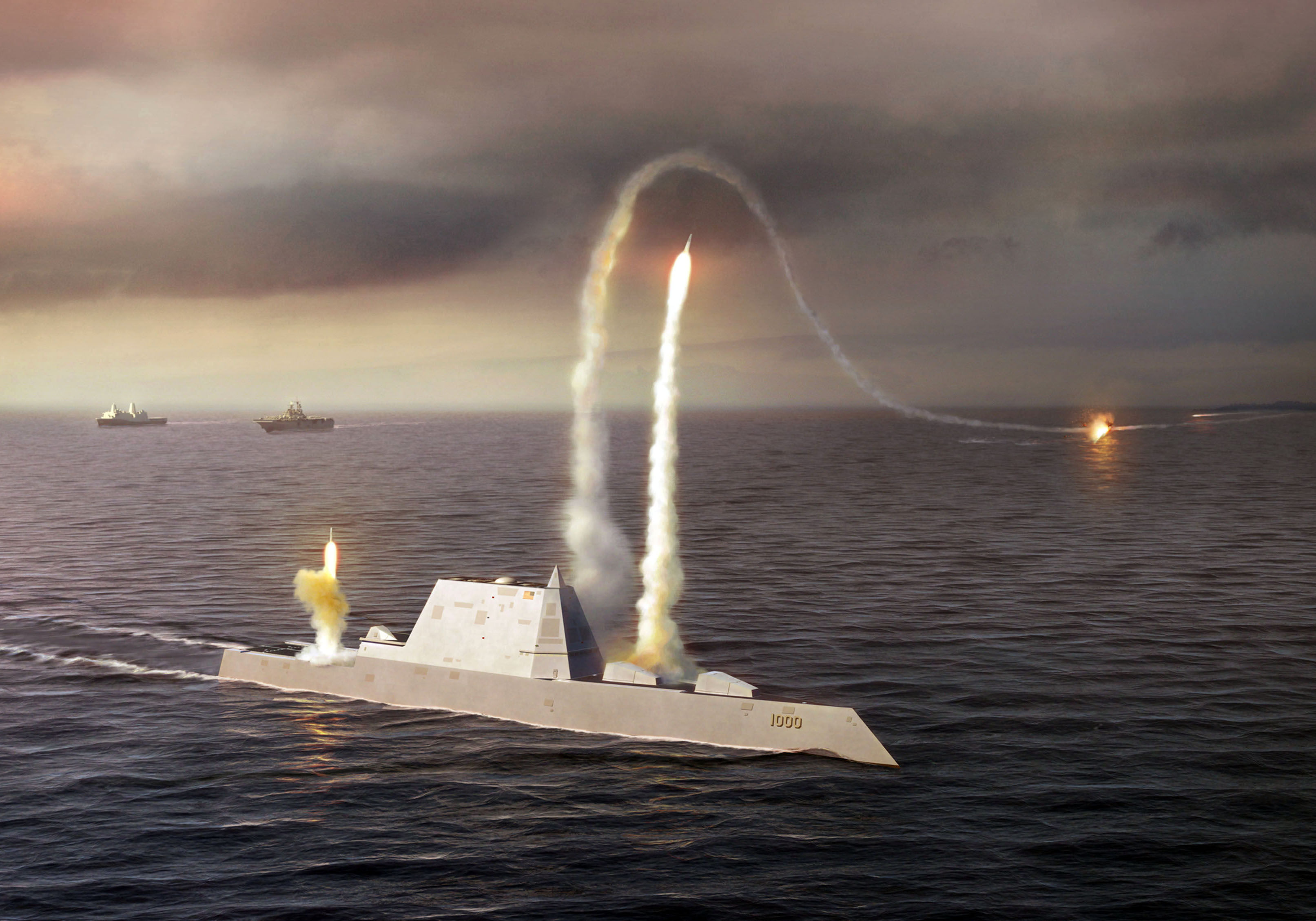
The latest darling of the US Navy is the USS Zumwalt Destroyer, a force to reckon with and on the top of the list of the US defense arsenal. Named after the renowned Chief of Naval Operations, Elmo Russell Zumwalt, Jr., the USS Zumwalt is the first in line of three such guided missile destroyers.
The origins of the ship’s basic features date back to 2001, as a result of Congressional defense cutbacks and the subsequent acquisition program. The source of the initial funding came from the National Defense Authorization Act of 2007. The summer of 2008 saw the formation of a construction timetable which was issued to the contractor, General Dynamics with a completion date targeted as March 2015. However, this deadline was later rescheduled to 2014. The first section of the ship was completed by the end of 2011. Despite much speculation about the commissioning being further delayed, the vessel was launched from Bath Iron Works on 29 October 2013.
More about the USS Zumwalt
The USS Zumwalt is a DDG-1000 class destroyer and it is one among a total of 3 destroyers of the same class, from the Bath Iron Works, the other two being the Michael Monsoor (DDG 1001) and Lyndon B. Johnson (DDG 1002) which are scheduled to be completed in 2015.
What makes the USS Zumwalt special is that it is the first of its kind to have some advanced features that were not available with previous ships. Although the bridge is constructed like any other regular ship’s bridge, the Zumwalt is fitted with software that enables the captain to control systems at any location onboard.
The Zumwalt is also equipped with some of the most advanced radar tracking systems, laser weapons and rail guns and a few gizmos that are still under test by the US Navy. However, the biggest asset of the Zumwalt is its stealth properties. The shielding is designed to make the ship show up as a mere fishing boat on enemy radar!
Other Special Features
The Zumwalt is fitted with Raytheon’s Integrated Indersea Warfare sonar, which is built from the type of sonar sensors which are used by sophisticated submarines. The high degree of computerization on board and the high level of automation cuts down manpower requirements drastically. In comparison the 210 sailors required to man an Arleigh-Burke-class destroyer, the USS Zumwalt only requires 130 personnel, with the addition of another 28 for aviation operations. There is a helipad on the ship which accommodates 2 helicopters and a vertical takeoff drone.

Budget Considerations
As can be well imagined, the cost of all the power and technology that is packed into the USS Zumwalt comes at a price, and a considerable one, at that. Originally, the projected budget of this ship was put at $3.8 billion. However, with all the added developmental costs involved, the original estimate has become inflated to $7 billion. The General Accounting Office initially felt that excessive technology was being pumped into a single vessel, more than required. Due to the huge size of the hull, General Dynamics had to spend $40 million on a building at the Bath Shipyard to accommodate it. It is a well-known fact that originally, 32 Zumwalt-class ships had been planned for, but when the initial estimates came out, this number was hurriedly chiseled down to 24, and the final number ended with just 3.

What it means to the US Navy
The basic objective behind the entire Zumwalt project, although not specifically spelt out by the US Navy, seems to be to show its military presence in the Pacific to counter China’s increasing military power in that area. It is a subtle or maybe not so subtle attempt at maintaining the balance of power in the region.
Future Plans
There are no plans to build more than 3 Zumwalt class ships. The US Navy will then revert back to building the traditional Arleigh Burke-class destroyers. It is estimated that even if extensive modernization is applied to these classical vessels, the costs will still be well below those incurred during the Zumwalt-class production line.

Reflections on the Zumwalt
The USS Zumwalt and the other associated Zumwalt-class destroyers represent a shot in the arm for the US Navy. It is through these vessels that the American military presence can somewhat renew its strength. Here is a vessel which has a lot of power packed into its punch, and enough technology added to make the force of the US Navy felt. However, this class of Navy vessel cannot be sustained indefinitely in the cash-strapped American economy. A balance has to be struck at some point. We have seen the birth of the USS Zumwalt, but how sure can we be about the emergence of the remaining two ships? What can be confirmed however is that the USS Zumwalt is here to stay. It continues to be a proud feather in the cap of the US navy.
Sources: