The Kiowa has played an important reconnaissance and supporting role for the ground troops, Apache Attack helicopters, and commanders on the ground over the past 40+ years when it was initially produced in 1969. The helicopter continued to be fielded until 1989, then it began a series of upgrades to keep it modern. The military brass is looking for a more modern air frame that can handle the support requirements of the Army, while trying to cut costs due to the declining budgets and lack of overseas combat missions.
The OH-58D’s being decommissioned will go to Davis-Monthan Air Force Base, AZ where they will either be scrapped, stored, or prepped for sale to civilian law enforcement for local and state support roles. Each Kiowa Warrior cost the Army roughly $5-$6 million initially, and $1.2 million to retrofit with upgrades. Over the years, the maintenance costs from personnel, storage, and parts has been very expensive as well. The true cost to maintain the fleet will never be known, but each helicopter would easily be in the millions over the lifetime of its use. It is also important to note that maintaining a Kiowa is vastly less in cost than maintaining the advanced AH-64D Apache.
English: The Louisiana National Guards two new UH-72 Lakotas touch down for the first time at Esler Field in Pineville, La. (Photo credit: Wikipedia)
The first Eurocopter UH-72 Lakotas entered production in 2006 with 300 being made initially. More are on the way and will eventually replace all OH-58Ds for the light scout role, but that is potentially several years out and there is nothing set in stone yet. The AH64-D and AH-64E are the Army’s main attack helicopters, which can also perform a scouting role. So the Army has opted to let the Apache “sub in” for the Kiowa until more Lakotas or another variant can be produced on a larger scale.
The Kiowas at Fort Rucker, AL (the Army’s main training base for helicopters) are being replaced by Lakotas right now.
Parting Thoughts
Overall, it does not sound like a good plan. Why would the Army get rid of an entire fleet of helicopters that cost around $5 million and replace their role with an attack helicopter that costs $35 million? Sure there are Lakotas that can help fill the gap, but there are only 300 Lakotas and those can only fill so many gaps of the nearly 2,200 Kiowas that are being phased out. The downsize is premature and a lot of good pilots are having to relearn different air frames. The Army’s primary scout capability via air is non-existent. Sure you can use drones to help fill the gap, but it just isn’t the same as a Kiowa with a rocket or hell fire package that can change the entire battle with one Kiowa team.
Just look at any scenario where there were Apaches needed to help ground troops – they were not always available. With an asymmetric battlefield and troops in contact in many places in the same day all over the battlefield, the Army needs a light scouting capability via air. With Kiowas, you can send 7 Kiowas for the price of 1 Apache. The Army scrapped the RAH-66 Comanche several years ago, causing even more upheaval in the air requirements. And with congress talking about scrapping the A-10 Warthog, the Air Force’s ground support aircraft, the forecast does not look good.
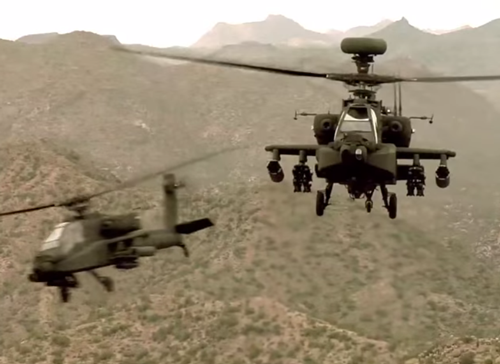
In this video John Schibler, the Boeing Chief Engineer of US Attack Helicopter Programs talks about the effectiveness of Boeing Defense, Space & Security’s newest model of Apache helicopter, AH-64E Guardian and tells how it acts as a safeguard for the soldiers serving on the ground.
Apache AH-64E Guardian like all the previous models has two engines, four blades and carries one pilot and one co pilot gunner. With a speed of 164 knots and range of 250 nautical miles it carries an aerial rocket system, automatic gun of 30 mm, hellfire missiles and an M239E1 chain gun. It is different from its predecessors in many ways. Not only it flies farther and faster than other Apache models but also it has more enhanced communication systems. The main feature that makes it different from others is that it is inter-operable with unmanned aircraft systems that enables the pilot to control the UAS sensors, weapon system and flight path (meaning it can control UAVs from the cockpit).
Apache helicopters are evidently known as deadliest helicopters for their destructive features, but Apache Guardian is more than that. Its “eye-in-the-sky” technology makes it yet more effective to keep the soldiers safe. It is capable of seeking and eliminating threats that otherwise would have remained undetectable and therefore makes it easy and safe for the soldiers to complete their assigned missions. So the name “Guardian” aptly suits this newest model of Apache as when it is around, the soldiers can have a breath of relief.
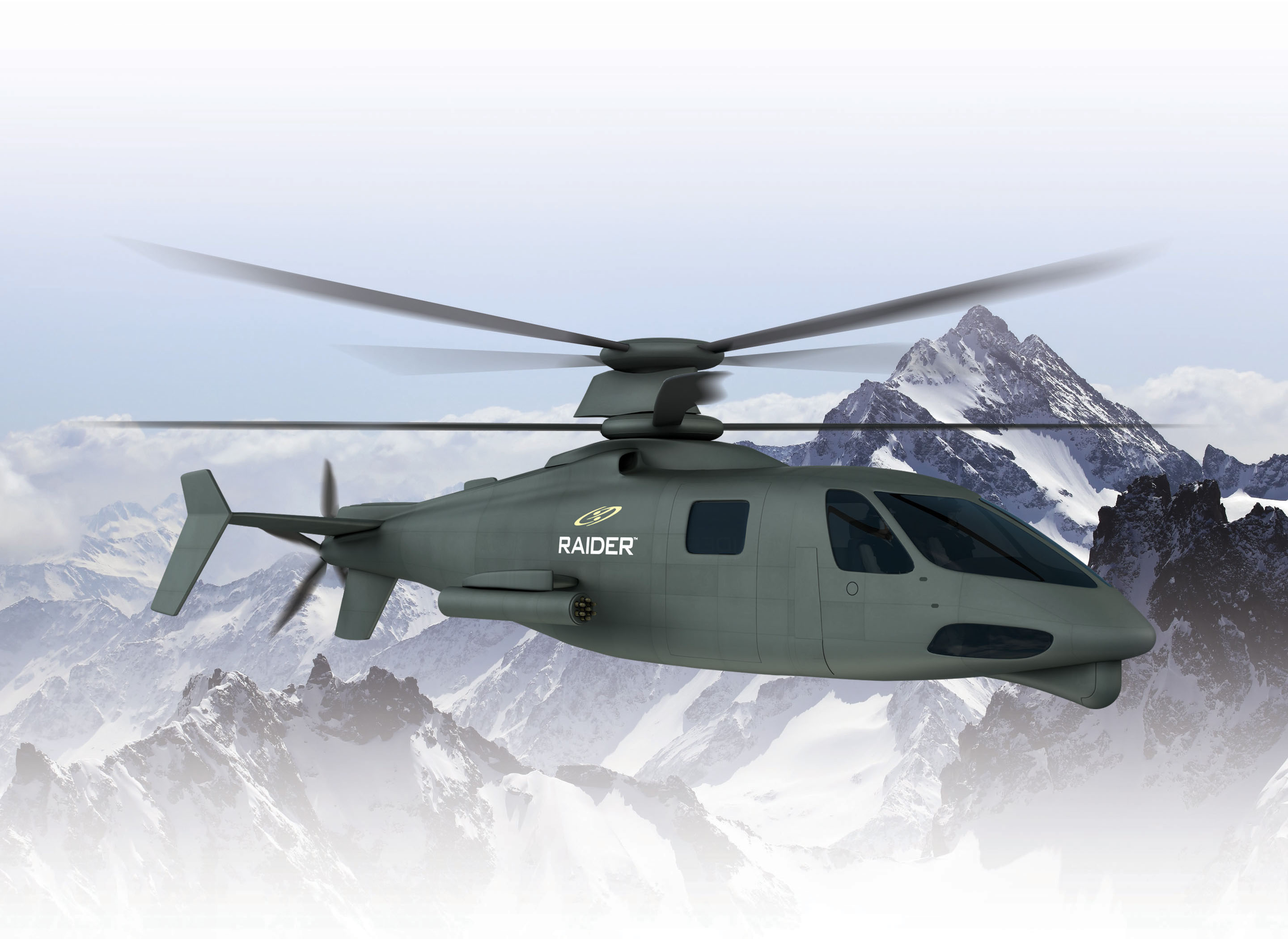
In March 2010, the Armed Aerial Scout program made a request for information for an advanced helicopter, and the result was the Sikorsky S-97 Raider as proposed by Sikorsky. Four years later, the company finally unveiled the first full production model of the groundbreaking scout and attack helicopter in the company’s facility in West Palm Beach, Florida.
The objective set for the new aircraft is to replace the army’s OH-58D Kiowa Warrior. However, specialists think that if the manufacturer’s claims about the Sikorsky S-97 Raider capabilities are true, it is almost certain that this helicopter’s reach will grow to cover a much wider audience. For instance, if the Sikorsky S-97 Raider proves useful, it might be used to replace other US Army military helicopters such as the MH-6 Little Bird used by the U.S. Special Operations Command. In addition to its expected military roles, The Sikorsky S-97 Raider could also be adapted to carry out civilian missions.
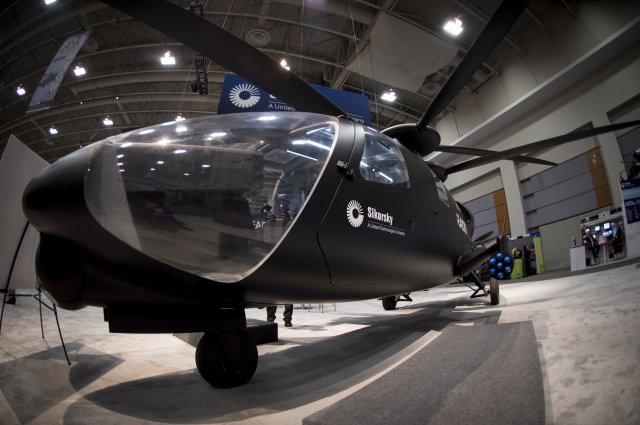
Sikorsky Raider at AUSA
Cost of the Sikorsky S-97 Raider
Up to now, Sikorsky and its various suppliers have invested in as much as $200 million on the two first prototypes of the helicopter. The company hopes to be able to produce this revolutionary helicopter at $15 million per unit.
The Sikorsky S-97 Raider is set to fly for the first time on December 2014. However, the aircraft’s first flight and its first demonstration of capabilities won’t take place until mid-2015.
Sikorsky S-97 Raider Design
Design is one of the most eye-catching attributes of the Sikorsky S-97 Raider. Being a compound helicopter, the Sikorsky S-97 Raider includes variable speed coaxial main rotors and a variable pitch pusher propeller. The helicopter is large enough for 6 passengers to fit in, and the side-by-side cockpit can contain two pilots. However, the S-97 is also designed so that it can fly autonomously.
Sikorsky UH-60M Black Hawk, Radom 2007 (Photo credit: Wikipedia)
As far as the engine is concerned, it is based on the Sikorsky X2 demonstrator. Until now, The Sikorsky S-97 is equipped with the same engine used in the UH-60M Black Hawk. Nonetheless, the company foresees the development of an improved engine for its new helicopter.
Key Dates
Here is a timeline of the key dates since Sikorsky first launched its X2 Technology Demonstrator in August 2008. These key dates are in conformity with the information provided by Sikorsky on their Sikorsky S-97 Raider website.
August 2008: X2 Technology Demonstrator™first flight
September 2010: X2 Technology Demonstrator reaches 250 knots
October 2010: S97 Raider™ launched
July 2011: X2 Technology Demonstrator final flight
January 2012: Initial Raider supplier team announced
March 2013: Raider Critical Design Review completed
September 2013: Raider aircraft #1 delivered, airframe final assembly begun
January 2014:Raider Systems Integrations Lab (SIL) fully operational
May 2014: Raider electrical power on achieved
October 2014: Raider Rollout Ceremony
December 2014: Raider first flight
2015:Raider flight test and Raider capability demonstrations
General Characteristics
The Sikorsky S-97 Raider has a capacity for six troopers including up to two pilots. The space inside the helicopter can be adjusted according to needs. Thus, if need be, the space in the cockpit of the aircraft can be used to store additional equipment or ammunition.
According to the information disclosed by Sikorsky, the S-97 Raider is 36ft long and weighs 8,945 lb. Its maximum takeoff weight is 11,400 lb. It is equipped with one General Electric YT706 powerplant, and its main rotor diameter is of 34 ft. The aircraft is 6-bladed variable pitch and clutchable pusher propellers.
Sikorsky S-97 Raider Performance
The S-97 has a staggering Never exceed speed of 276 mph (240kn), and a cruising speed of 253 mph (200kn) external weapons included. The weapons include 50 cal guns w/500 rounds and a seven shot rockets pod, Hellfire missiles and 2.75” rockets. The range exceeds 600 km, and it has an endurance mean of 2.7 hours on standard fuel. In addition, the S-97 is also capable of aerial refueling.
An OH-58D Kiowa Warrior from 1st Battalion (ATTACK), 25th Aviation Regiment, 25th Infantry Division (L), “Lightning Attack”, patrols the skies over , . Lightning Attack deployed from Schofield Barracks, Hawaii to Iraq in January and is conducting aerial reconnaissance, close combat attacks and security missions for the 1st Armored Division and the 1st Cavalry Division in support of Operation Iraqi Freedom. (Original caption) (Photo credit: Wikipedia)
Comparisons
As a matter of fact, the new and futuristic Sikorsky S-97 Raider is produced in order to replace the army’s OH-58D Kiowa Warrior, an aircraft that has been in service since the 1960’s and which has been used in many wars by the US Army such as the Iraq and Afghanistan wars. Thus, while, there are some similarities between the two helicopters, the Sikorsky S-97 Raider is clearly much more advanced at all levels.
In his article published in The Aviationist website, David Cenciotti compares the new Sikorsky S-97 Raider with the “mysterious stealth” aircraft that was used in the raid on Osama Bin Laden.
Cenciotti states, “it is safe to believe that Sikorsky has embedded some of the features developed for the secret, radar evading US Army Stealth Black Hawk used by the Navy SEALs at Abbottabad in May 2011,”
Future Plans for the Sikorsky S-97 Raider
Sikorsky seems to be leading the way and setting an example to other companies on how to get things done. Not only does Sikorsky build state-of-the-art machines, but it also invests in future development opportunities. For example, as recently as in May 2014, Sikorsky won a U.S. Navy deal for the President’s Marine One helicopters. According to Reuters, the company “won an initial $1.24 billion contract to develop and build six new U.S. presidential helicopters, the first step toward a fleet of 21 new aircraft by 2023.”
Other future plans of the company include teaming up with other leading companies such as Boeing and Aurora Flight Sciences to manufacture new aircraft. In addition to all these recent successes, Sikorsky and Boeing have also been chosen to work hand in hand in order to produce the SB>1 Defiant, which is a “medium-lift-sized demonstrator.” The demonstrator is built for Future Vertical Lift and is expected to fly in 2017 as advanced by Sikorsky in a press release.
Final Thoughts
It is probably safe to say that during its 90 years of existence, Sikorsky is now stronger than ever. The rumors about the company’s divestiture have calmed down especially after the company was awarded a $1.24 billion deal to build the presidential helicopters. Therefore, although the Sikorsky S-97 Raider is one of the least revenue generating units belonging to United Technologies, the company isn’t thinking about selling it or spinning it off.
If Sikorsky continues its innovative efforts, it will eventually find more and more reliable customers than the US Army. This idea of using helicopters for civilian duties might be an interesting alternative, and selling the Sikorsky S-97 Raider to American allies could also help widen the company’s business opportunities.
Before we get into the specifics of the MQ-9 Reaper Drone, one of the deadliest drones in the US arsenal, we must first cover some history.
History of the Drone
A third of the US Air Force’s aircraft is estimated to comprise of drones today. The concept of drones is not a new one. The history of drones or Unmanned Aerial Vehicles (UAVs) dates back to the 1930s with the development of the “Queen Bee” by the British Royal Navy.However, it was not until 1995, that concerted efforts were commenced by the United States to develop drones for military applications. The MQ-1 Predator (Predator A) was first put into use in 1995. It began as a surveillance vehicle and data gatherer, but was later fitted with Hellfire Missiles, for targeting suspected terrorists. It was created as a result of a directive from the Department of Defense for counter-insurgency measures at overseas locations.
Reasons for MQ-9 Reaper Drone Development
As a result of the war with Iraq, and in the aftermath of the 9/11 attacks, a need was felt to step up counter-terrorist measures by the US armed forces. The ongoing war with Afghanistan also reinforced this conviction. In 2007, the first test flights of the MQ-9 Reaper Drone were carried out at the Creech Air Force Base in Nevada. This new series of drones was first pressed into service in actual combat in Iraq and Afghanistan later during the same year. This was followed by successful missions in other countries like Ethiopia and Libya.
English: An MQ-9 Reaper unmanned aerial vehicle flies a combat mission over southern Afghanistan. (Photo credit: Wikipedia)
MQ-9 Reaper Drone Technical Specifications
The MQ-9 Reaper Drone (Predator B) was developed as an improvement to the MQ-1 Predator (Predator A). It is bigger and better than the MQ-1 Predator in terms of power and munitions delivery. The codification of the drone is as follows: “M” stands for Mulirole, “Q” for Unmanned Aerial Vehicle and “9” is the series designation.3
This drone is described as an armed drone of medium, multi-mission, medium-altitude capabilities. Its primary function is that of intelligence collection and the secondary function is attack on dynamic execution targets.
The MQ-9 Reaper is totally remote-controlled. It is fitted with a Multi-Spectral Targeted System, consisting of visual, infra-red and laser sensors. The munitions system is also laser-guided. The suite of functions that the Reaper can perform is surveillance, reconnaissance, precision strike, search and rescue during combat, convoy/raid over-watch, air support, buddy-laser, and terminal air guidance, development of targets and clearance of routes. The aircraft is fully-equipped with sensors and weapons with a satellite link between the drone and the ground control station. The entire aircraft can be dismantled and transported in a C-17 transporter or larger, but is also capable of independent taking off and landing from a standard US airfield.
Here is a summary of some of the specifications of the MQ-9 Reaper:
$56.5 million (4 aircraft with associated equipment)
Other MQ-9 Reaper Drone Buyers
The primary customer of the MQ-9 Reaper is the US Air Force and the US Government. However, the sale of this drone is not restricted to the US alone. In 2011, the US Department of Defense signed a contract with General Atomics Aeronautical Systems to supply 24 extra systems of the MQ-9 Reaper to the Italian Air Force. The total value of the contract was tagged at $15,053,926.
In 2013, the Netherlands declared that it would be acquiring its own fleet of Reapers by the year 2017, amounting to 4. Today, France and the UK are also using MQ-9 Reapers, making this drone a global product.
MQ-9 Reaper (Photo credit: Wikipedia)
Future Plans of the MQ-9 Reaper Drone
The MQ-9 Reaper has had a good tour of duty. However, it is likely to be replaced by the next generation of drones. The Army is now developing the successor to the Reaper – the Avenger (Predator – C), a sleeker and more robust design, compared to the Reaper. The main features which differentiate the Avenger from the Reaper is that the Avenger is jet-propelled and it is has stealth properties and the cruise speed is double that of the Reaper.
MQ-9 Reaper Drone Final Analysis
If we consider the track record of the MQ-9 Reaper, it would be fair to say that it has had a fairly successful journey. One thing is sure, and that is, unmanned aircraft will play a prominent role in the US Air Force in the future years. When Secretary of Defense, Robert M Gates addressed the Air Force Academy in 2011, he mentioned that although there will always be a need for manned flight in the US military, there is a great scope for the development of remotely piloted vehicles, for reconnaissance and strike. “I see no excuse for men in fighter planes to shoot down bombers,” he says, “The next Air Force is going to be built around scientists.”
It appears the MQ-9 Reaper Drone will continue to see heavy use for many years to come, until such a time as it is fully replaced by the Predator 3 and future models.