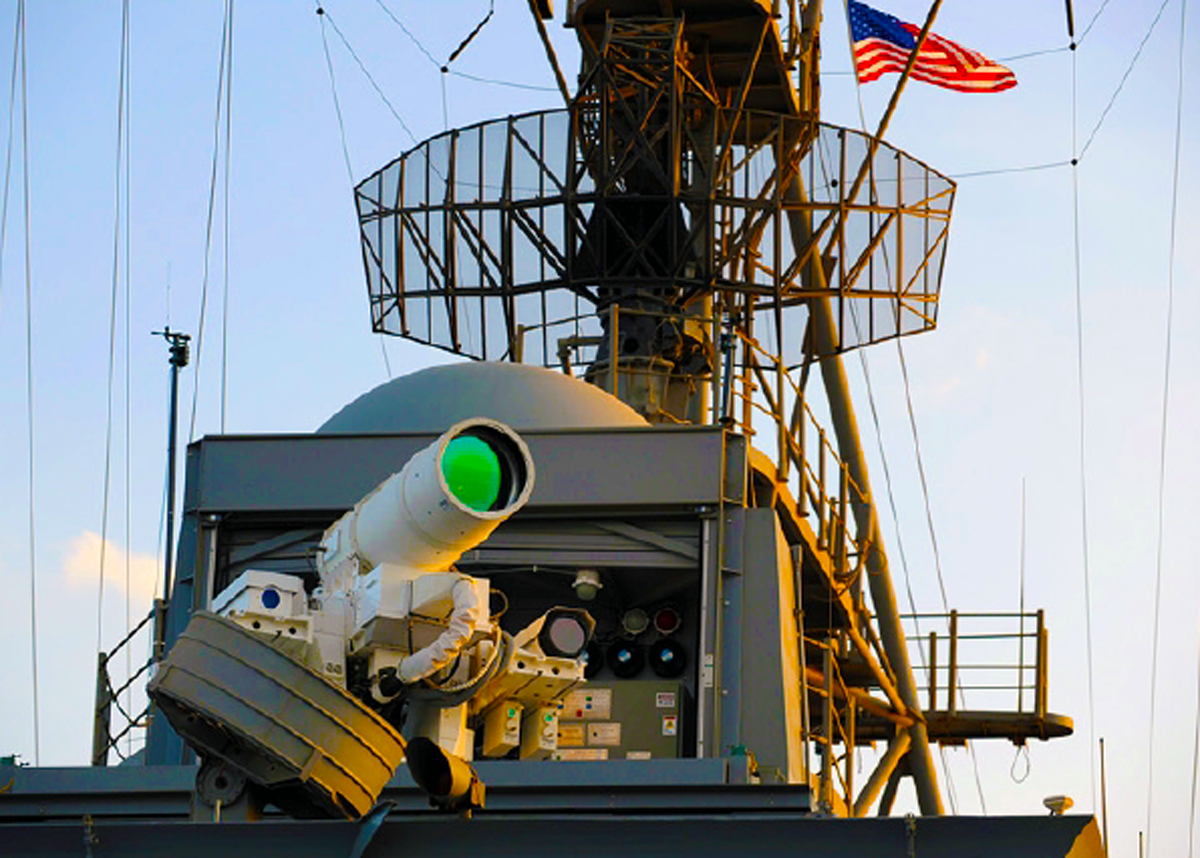
The USS Ponce (LPD-15) fired a laser beam destroying aerial and naval targets for the first time in history. The office of Naval Research conducted the test. Never before has a laser beam of this size been able to do so much damage from a ship.
The way the weapon works is similar to a video game controller. Just point and shoot. Instantly the target receives a laser beam at the speed of light and the target is destroyed.
The USS Ponce is a member of the 5th Fleet out of Bahrain, commanded by Captain Dale W. Maxey.
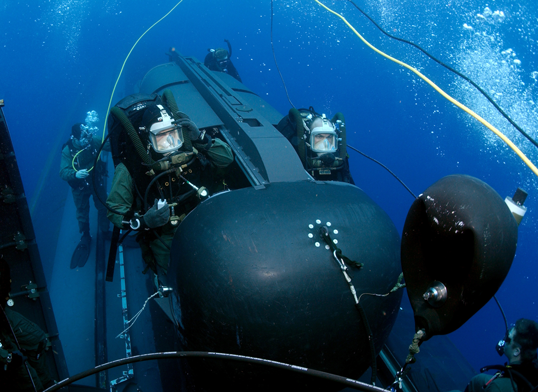
During a promotional video showing multiple Naval ships and assets, the Navy showcases their ability to strike on land in a covert fashion. The Navy SEALs are seen maneuvering a submarine-launched SDV (SEAL Delivery Vehicle). The SDV launches from a Dry Deck Shelter off of the top of a submerged submarine. With these kinds of capabilities at the U.S. Navy’s disposal, there is not type of sea-to-ground requirements they can not accomplish. With this capability, the Navy can literally show up and destroy any target without being detected and by limiting the danger to the SEALs when doing so. A fast boat has nothing on the SDV. Rumor has it that SDVs have been in operation for decades. They were first used starting in 1952 under a different name – “Swimmer Delivery Vehicles”. The SDVs have evolved over the years adding technology and launch capability like the Dry Deck Shelter among other communication, detection-prevention, weaponry, reconnaissance and navigation technology.
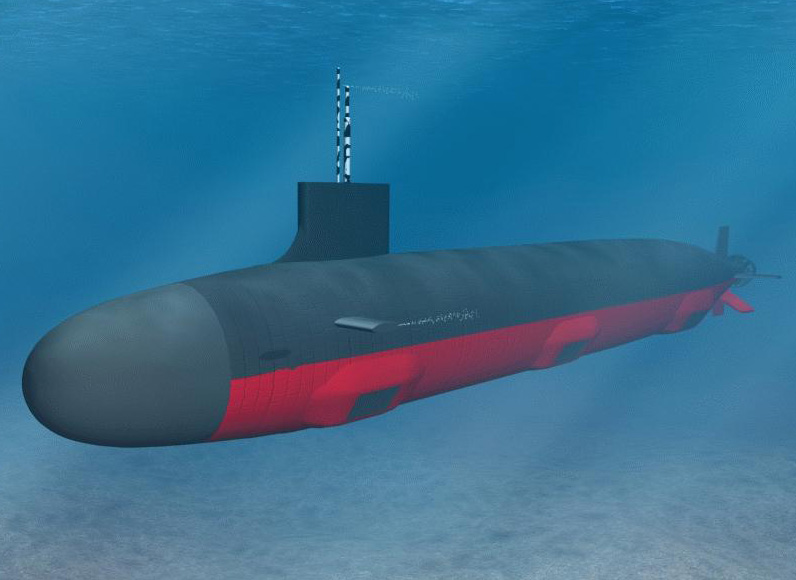
In April 2014, the US Navy made public its latest intention to contract 10 new submarines (the Virginia Class submarine). This contract consists of Block III of the 3-block supply schedule. Blocks I and II have already been delivered. The total value of the contract is estimated to be $17.645 billion. The model is SSN 774 Virginia-class, and they are nuclear power attack submarines. The contract has been awarded to two companies – General Dynamics Electric Boat and Huntington Ingalls Newport News Shipbuilding. The supply will commence in 2018, with two subs each year, one from each yard, for a period of 5 years, until the year 2023.
English: GROTON, Conn. (June 21, 2008) Pre-commissioning Unit New Hampshire (SSN 778) sits moored to the pier at General Dynamics Electric Boat shipyard moments before her christening ceremony commenced. New Hampshire, the fifth Virginia class submarine built, was officially christened by sponsor Cheryl McGuinness. U.S. Navy photo by John Narewski (Released) (Photo credit: Wikipedia)
Impact of the Contract
This contract has literally created waves in the Navy and shipbuilding circles. Financially, it is considered the biggest contract ever to be awarded in the history of the US Navy. Rear Adm. Dave Johnson who is the executive officer for submarines at Naval Sea Command (NAVSEA) is all praise for the contract. He says that it reinforces a solid relationship between the Navy and industry as far as the Virginia-Class program is concerned. He has called this program “a model of acquisition excellence.”
Shipbuilders also had their say by stating that it is the largest contract till date in terms of number of boats ordered in a single contract, which is especially unique in today’s scenario, considering the current economic and political situation. The president of the Electric Boat, Jeffrey Geiger, says that if they are able to supply two ships a year, it will greatly enhance the US Navy’s undersea dominance.
The hull numbers are designated SSN 792 to SSN 801, but these submarines have not yet been named. The US Navy already has 10 Virginia-class submarines. There are another eight in the process of being built. Almost all contracts for Virginia-class subs have been awarded on the basis of multiyear contracts which creating cost-efficiency in the long run.
Virginia (SSN 774) returns to the General Dynamics Electric Boat shipyard following the successful completion of its “alpha” sea trials in 2004. (Photo credit: Wikipedia)
Specifications and Costs of the Virginia Class Submarine
Although the amount quoted in the contract is for $17,645,580,644, there are options for on-board repair parts, so the total value of the contract could touch $17,827,808,738.
Even though some foreign competitors had more sophisticated models in their proposals; these 10 Virginia-class submarines will basically contain all the existing features of this class, but with some new ones added on. Incremental integration of new technologies will be added to the main structure.
Submerged, each sub displaces 7,800 tons. The hull is 377 feet long and 34 feet in diameter. The submarines will be able to reach speeds in excess of 25 knots and the diving depth will be over 800 feet. Each submarine will carry Mark 48 advanced capability torpedoes, along with Tomahawk missiles and also unmanned underwater vehicles.
So, let us take a closer look at the specs of the Virginia-class Submarines of the US Navy. In addition to the points mentioned above, the hull has structurally integrated enclosures. Designed for easy repair, maintenance and upgrade. It has modular deck structures, which makes it easy to install and maintain. The diving control and steering of the submarine is accessed through a joystick of 4 buttons and a double axis. Being a stealth vessel, the submarine has a low acoustic signature which is achieved through anechoic coatings and a specially-modified engine.
USS North Dakota (SSN-784) (Photo credit: Wikipedia)
What’s New in the Block III Submarines?
One major difference in the Block III submarines is in the payload tubes. They are designed to reduce cost and at the same time, increase the scope of missile-firing capabilities. Up till now, a Virginia Class submarine has 12 separate vertical launch tubes with a diameter of 21 inches for firing Tomahawk missiles. The Block III submarines, however, have only two tubes of 87 inches in diameter, where each tube has the capability of launching 6 Tomahawk missiles.
Although the main motivation behind the modification of the launch tubes is cost-reduction, it also increases the possibility of future missiles and launching of off-board sensors from these tubes. The Virginia Class Submarines also have the special characteristic of fly-by-wire technology, where the entire controls are computerized, and the submarines are driven by the touch of a button or touchscreen controls. This is unlike the earlier versions of submarines which used to run on mechanized hydraulics.
The Large Aperture Bow array of the Block III submarines also establishes an advanced sonar system in the boat’s bow, known as the conformal sonar system.3
The LAB array is an improvement over the previous spherical arrays which enable enhanced passive listening capabilities. There is also a medium-frequency active array added to the LAB array. The hydrophones are based on previous designs and serve the usual functions of either locating active reflected sounds or incoming passive sounds.
USS Florida launching a Tomahawk cruise missile (Photo credit: Wikipedia)
Future Plans for the Virginia Class Submarine
The US Navy has great plans on the anvil, and the Block III submarines are likely to receive the new technology as it is handed out. There is talk of the development of futuristic weapons by the US Navy like Laser weapons, which are being currently tested in the Persian Gulf and electromagnetic rail guns which uses electromagnetic force to send a missile over a long range at mind-boggling speeds. The Virginia Class Submarine will change the way undersea battles are fought.
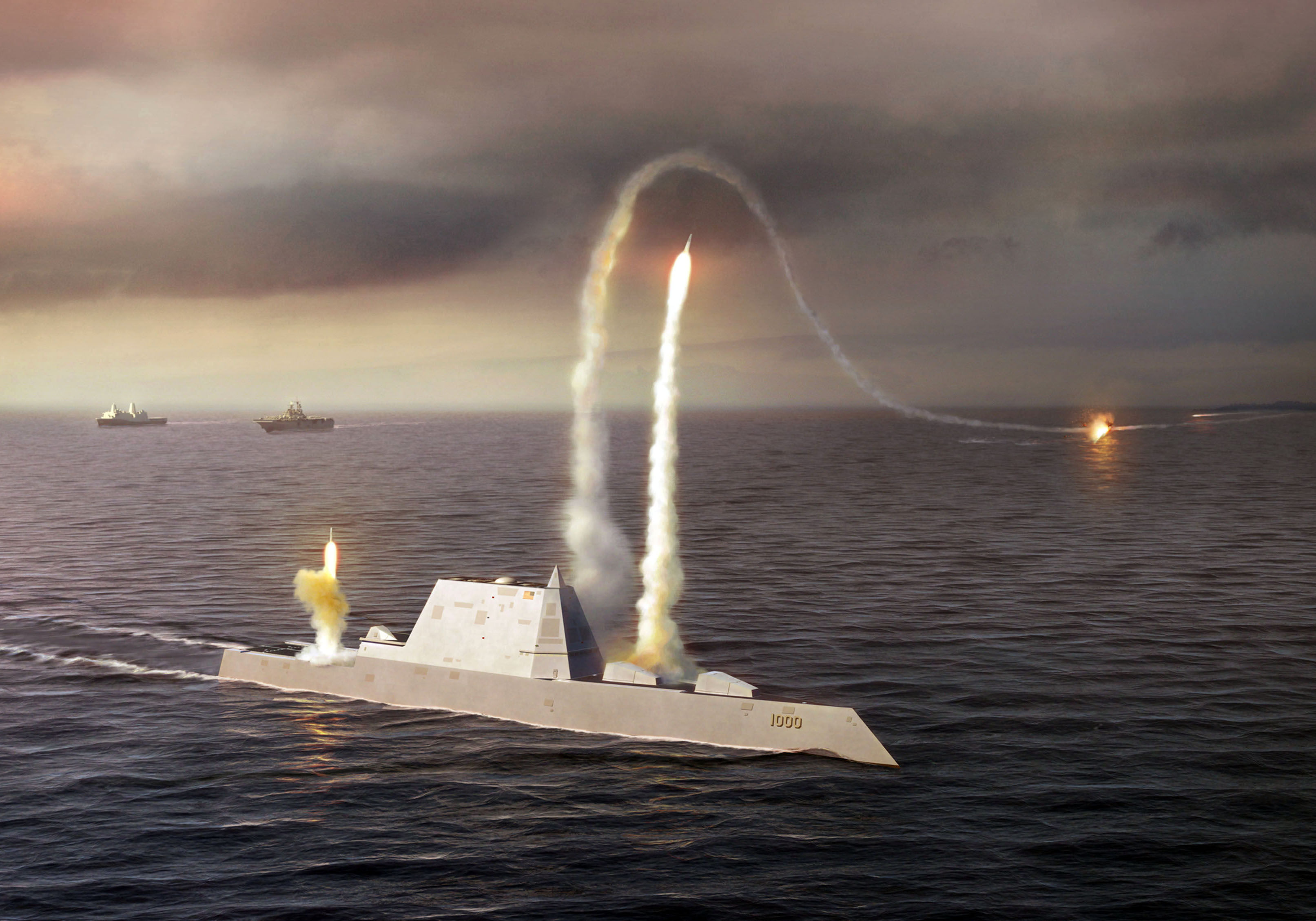
The latest darling of the US Navy is the USS Zumwalt Destroyer, a force to reckon with and on the top of the list of the US defense arsenal. Named after the renowned Chief of Naval Operations, Elmo Russell Zumwalt, Jr., the USS Zumwalt is the first in line of three such guided missile destroyers.
The origins of the ship’s basic features date back to 2001, as a result of Congressional defense cutbacks and the subsequent acquisition program. The source of the initial funding came from the National Defense Authorization Act of 2007. The summer of 2008 saw the formation of a construction timetable which was issued to the contractor, General Dynamics with a completion date targeted as March 2015. However, this deadline was later rescheduled to 2014. The first section of the ship was completed by the end of 2011. Despite much speculation about the commissioning being further delayed, the vessel was launched from Bath Iron Works on 29 October 2013.
More about the USS Zumwalt
The USS Zumwalt is a DDG-1000 class destroyer and it is one among a total of 3 destroyers of the same class, from the Bath Iron Works, the other two being the Michael Monsoor (DDG 1001) and Lyndon B. Johnson (DDG 1002) which are scheduled to be completed in 2015.
What makes the USS Zumwalt special is that it is the first of its kind to have some advanced features that were not available with previous ships. Although the bridge is constructed like any other regular ship’s bridge, the Zumwalt is fitted with software that enables the captain to control systems at any location onboard.
The Zumwalt is also equipped with some of the most advanced radar tracking systems, laser weapons and rail guns and a few gizmos that are still under test by the US Navy. However, the biggest asset of the Zumwalt is its stealth properties. The shielding is designed to make the ship show up as a mere fishing boat on enemy radar!
Other Special Features
The Zumwalt is fitted with Raytheon’s Integrated Indersea Warfare sonar, which is built from the type of sonar sensors which are used by sophisticated submarines. The high degree of computerization on board and the high level of automation cuts down manpower requirements drastically. In comparison the 210 sailors required to man an Arleigh-Burke-class destroyer, the USS Zumwalt only requires 130 personnel, with the addition of another 28 for aviation operations. There is a helipad on the ship which accommodates 2 helicopters and a vertical takeoff drone.
080214-N-0923G-005 WASHINGTON A model of the DDG 1000 Zumwalt Class destroyer to be built by Bath Iron Works and Northrop Grumman Shipbuilding is displayed during a contract signing ceremony at the Pentagon. Both companies signed $1.4 billion construction contracts with the Navy as part of the Navy dual lead-ship strategy to introduce the new class of destroyer that will deliver improved warfighting capabilities, continued forward presence and combat power for the surface Navy. ) (Photo credit: Wikipedia)
Budget Considerations
As can be well imagined, the cost of all the power and technology that is packed into the USS Zumwalt comes at a price, and a considerable one, at that. Originally, the projected budget of this ship was put at $3.8 billion. However, with all the added developmental costs involved, the original estimate has become inflated to $7 billion. The General Accounting Office initially felt that excessive technology was being pumped into a single vessel, more than required. Due to the huge size of the hull, General Dynamics had to spend $40 million on a building at the Bath Shipyard to accommodate it. It is a well-known fact that originally, 32 Zumwalt-class ships had been planned for, but when the initial estimates came out, this number was hurriedly chiseled down to 24, and the final number ended with just 3.
English: Zumwalt class destroyer (side view) (Photo credit: Wikipedia)
What it means to the US Navy
The basic objective behind the entire Zumwalt project, although not specifically spelt out by the US Navy, seems to be to show its military presence in the Pacific to counter China’s increasing military power in that area. It is a subtle or maybe not so subtle attempt at maintaining the balance of power in the region.
Future Plans
There are no plans to build more than 3 Zumwalt class ships. The US Navy will then revert back to building the traditional Arleigh Burke-class destroyers. It is estimated that even if extensive modernization is applied to these classical vessels, the costs will still be well below those incurred during the Zumwalt-class production line.
English: PACIFIC OCEAN (Aug. 16, 2009) The Arleigh Burke-class guided-missile destroyer USS Mustin (DDG 89) transits the western Pacific Ocean. Mustin is one of seven Arleigh Burke-class destroyers assigned to Destroyer Squadron (DESRON) 15 and operates from Yokosuka, Japan. (U.S. Navy photo by Mass Communication Specialist 2nd Class Bryan Reckard/Released) (Photo credit: Wikipedia)
Reflections on the Zumwalt
The USS Zumwalt and the other associated Zumwalt-class destroyers represent a shot in the arm for the US Navy. It is through these vessels that the American military presence can somewhat renew its strength. Here is a vessel which has a lot of power packed into its punch, and enough technology added to make the force of the US Navy felt. However, this class of Navy vessel cannot be sustained indefinitely in the cash-strapped American economy. A balance has to be struck at some point. We have seen the birth of the USS Zumwalt, but how sure can we be about the emergence of the remaining two ships? What can be confirmed however is that the USS Zumwalt is here to stay. It continues to be a proud feather in the cap of the US navy.